Turkey blocks 419 social media accounts of LGBTQ+ activists and journalists
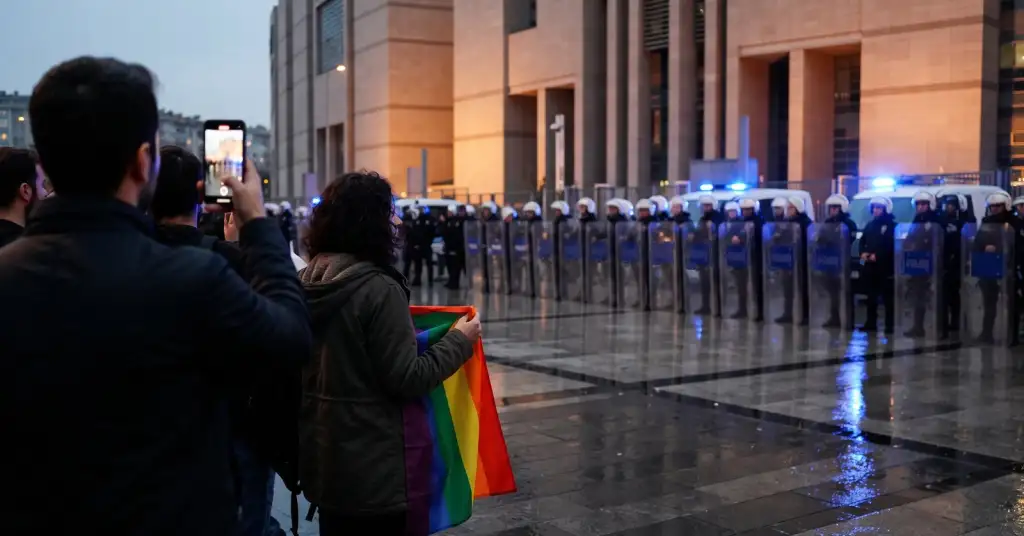
An Istanbul court on Wednesday 16 September ordered access blocks on 419 social media accounts for "obscene content", and overnight into Thursday courts across Turkey formalised at least 80 arrests of LGBTQ+ activists, their supporters and journalists, Balkan Insight reports. The accounts on the list include journalists, media outlets and women's organisations; among them is Şirin Payzın, a veteran television journalist with 1.8 million followers on X, whose account the platform made invisible inside Turkey within hours. The 106 people detained on Tuesday outside the Çağlayan courthouse, where they had gathered to demand the release of activists arrested earlier, were let go. Everything else about the operation the government calls "My Family Is Safe" has widened since it began on 12 September: from LGBTQ+ associations to Amnesty International's Turkish branch, from university clubs to Sky News's special correspondent, from Instagram to X. The blocks are enforced by the platforms as country-withheld content, which means every one of those accounts still opens through a VPN, and everyone in Turkey knows it.
In brief
- The operation announced by Justice Minister Akın Gürlek covers 162 suspects, nine associations and 13 businesses in 15 provinces, on allegations of facilitating prostitution and producing or distributing obscene material. Courts have jailed 16 people in İzmir, 7 in Ankara and 28 in Mersin, and ordered at least 80 formal arrests on Wednesday night and Thursday morning.
- Blocking began on 12 September with LGBTQ+ organisations, added 32 X accounts of university groups on 13 September, then Amnesty Turkey, the Evrensel daily, Academics for Peace and the Media and Law Studies Association on 14 September under Article 8/A of Internet Law 5651, then journalists and women's federations on 16 September, then the 419-account "obscenity" list.
- Amnesty counted more than 180 blocked or restricted accounts by Tuesday; the Freedom of Expression Association's EngelliWeb monitor is updating the list daily. On 14 September the Justice Ministry told all 175 chief prosecutors to seek removal or blocking of anything "obscene or harmful to children".
- X withholds the accounts by country on the state's request and says so in the account's place; outside Turkey and over a VPN they load normally, the same mechanism we described when India ordered 195,000 takedowns.
How the list grew in five days
The sequence is documented by EngelliWeb, the blocking monitor run by the Freedom of Expression Association (İFÖD), and it shows a police operation against one community turning into a censorship operation against everyone who reported on it. On 12 September, the day of the raids on associations, bars and activists' homes, the first blocks hit the accounts and websites of LGBTQ+ organisations including Kaos GL and the lawyer Levent Pişkin. On 13 September another 32 X accounts followed, mostly university LGBTQ+ and gender-studies clubs, and a separate Istanbul court blocked dozens of accounts for obscenity. On 14 September, a Sunday, the Bakırköy 4th Criminal Court of Peace used Article 8/A, the national-security and public-order clause, against Amnesty International Turkey, Evrensel, the Media and Law Studies Association, Academics for Peace, the Sky News correspondent Alex Crawford, the Kaos GL editor Yıldız Tar and a list of journalists, lawyers and labour groups. Amnesty said X told it the request came from the Cyber Security Presidency. On 16 September the list reached the journalists İrfan Değirmenci and Şirin Payzın, the left-wing outlet soL Haber, the Women's Coalition and the Federation of Women's Associations of Turkey, two of more than 120 women's organisations that had signed a declaration against the raids. On the same day the Istanbul Police, coordinated by the Cyber Crimes Investigation Bureau, announced the 419-account block that Anadolu Agency reported as protecting "families, children and young people from all forms of abuse". Which content was obscene has not been said.
What "withheld in Turkey" means, and what it does not
Turkey's blocking orders do not take an account down. Under Law 5651 the state sends the decision to the platform, and X, which has complied with hundreds of such requests since the 2025 arrest of Istanbul's mayor, replaces the account with a notice that it is withheld in Turkey in response to a legal demand. Instagram does the same with less transparency. The account, its history and its followers remain intact for the rest of the world and for anyone inside Turkey whose traffic exits the country through a VPN, which is why Evrensel could tell readers that if its account went dark it would announce a new one, and why Amnesty could note that its account was "accessible outside the country" while filing its objection. The government knows this too; the point of a withheld notice is not to make the speech disappear but to attach a cost to it, to mark the speaker and to move the audience one step further from the default. Payzın's response on Wednesday was addressed to that logic: "If you think that banning journalists and shutting down accounts will solve the problems, unfortunately you're very mistaken." The arrests are the other half of the same message. Same-sex relations are not illegal in Turkey; the charges are obscenity and facilitating prostitution, the president's language is "deviant movement", and the Justice Ministry's instruction to every prosecutor in the country to hunt for material "harmful to children" gives the campaign a legal engine that does not depend on any one court.
The pattern, and the practical part
Turkey has run this play before. After the mayor of Istanbul was detained in March 2025 the authorities sought blocks on more than 700 X accounts of news outlets, journalists, politicians and students; X called the orders unlawful and took 126 of them to the Constitutional Court. In June, some 40 feminist and LGBTQ+ accounts were withheld during Pride month. The novelty of September is the pairing of raids and arrests with the blocks, and the extension from the targeted community to the press covering it within 48 hours. For readers in Turkey the mechanics matter more than the politics. A withheld account is a country-level filter applied by the platform to sessions it locates in Turkey; a VPN with an exit elsewhere restores the feed, the archive and the ability to follow. Using one is not an offence, and the state has so far preferred to throttle and pressure VPNs rather than ban them outright. What a VPN does not do is protect the account owner: the people on the 419 list are identified by name, and eighty of them are in custody.
What happened in Turkey this week?
Who is Şirin Payzın and why does her account matter?
Are the accounts deleted?
On what legal basis?
Is using a VPN to see the accounts legal in Turkey?
• Turkey Blocks Social Media Accounts, Arrests 80, as LGBT Crackdown Expands - Balkan Insight
• Turkey expands X blocking orders to journalists, women's groups amid LGBT crackdown - Turkish Minute
• Turkish court orders social media accounts of Amnesty Turkey, rights groups, journalists blocked - Turkish Minute
• İrfan Değirmenci, Şirin Payzın, soL Haber ve kadın örgütlerinin hesaplarına erişim engeli - EngelliWeb (İFÖD)