Poland's Sejm again passes a law letting the regulator block websites without a court
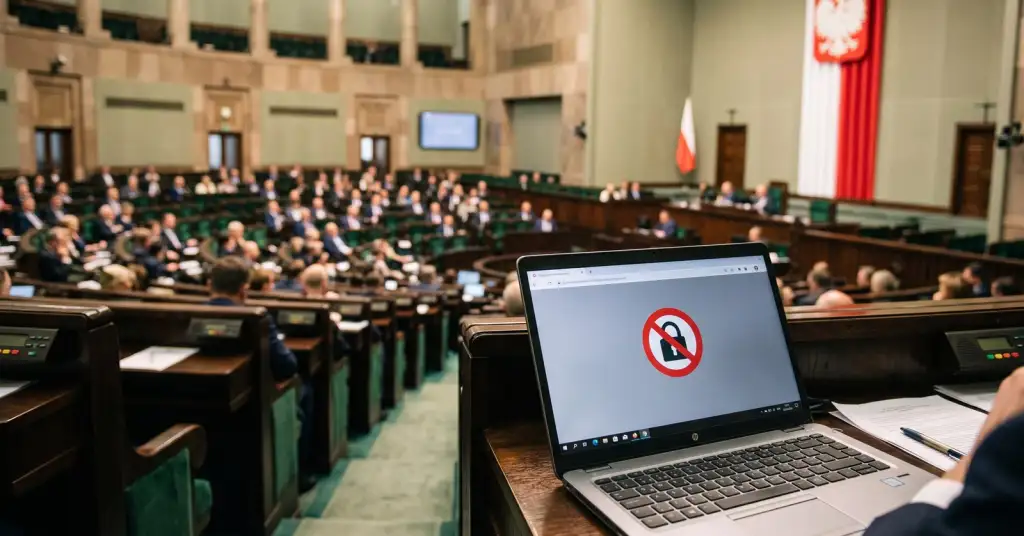
Poland's lower house has again passed a law that would let the telecoms regulator order online content to be blocked without first going to a judge. The Sejm adopted the bill on October 8 by 242 votes to 61, with 136 abstentions. It is the government's second attempt: in January President Karol Nawrocki vetoed the first version, comparing it to censorship from Orwell's "1984". The bill now goes to the Senate and then back to the president.
Who could block what
The bill writes the EU's Digital Services Act into Polish law and adds a national procedure for removing illegal content. Blocking orders could be issued by courts and by "competent authorities": the president of UKE, the telecoms regulator, and for some video platforms the chair of KRRiT, the broadcasting council. Prosecutors, the police, the National Revenue Administration (KAS) and the Border Guard could ask for fast blocking. The cases listed include child sexual abuse material, identity theft, fraud and copyright infringement. Polish tech site Android.com.pl lists among the targets unlicensed streaming services, sites with pirated music and books, fake online shops, phishing pages and some public channels on messengers and social networks.
Platforms and other online service providers would have to block whatever an order names. UKE would also keep a register of websites used to distribute illegal content. A person whose post was blocked could ask for it to be restored, but only after first complaining through the platform's own reporting system, and could then challenge the order in an ordinary court. An order would normally not take effect while it is being challenged. An amendment from PiS and Polska 2050 makes orders against sexual content involving minors or animals and especially graphic material enforceable immediately.
Why it came back now
The Digital Services Act has applied across the EU since February 2024, and Poland risks fines from the EU Court of Justice for not putting national rules in place. The vote also came after two school attacks: on October 7 a 19-year-old stabbed nine people at a vocational school in Ostrołęka, and on October 8 a 15-year-old stabbed three people at a school near Wyszków, killing a 37-year-old janitor. Prime Minister Donald Tusk said most of the evil pulling young people toward crime hides on the internet and that the state needs to be able to block hate speech immediately. Digital Affairs Minister Krzysztof Gawkowski said Poland must have "a whip for digital platforms".
The opposition Konfederacja voted against and PiS abstained. Zbigniew Bogucki, head of the President's Chancellery, said the new text differs little from the vetoed one and that the president would sign a good law.
What it would change
In the EU only a handful of countries let officials block websites without a prior court order, among them Italy, Greece, Portugal and Germany. Our country-by-country guide to blocking without a court tracks them. If the Senate passes the bill and Nawrocki signs it this time, Poland would join that list. A judge would look at a block only if someone challenges it, not before the content goes dark. Whether the president signs is the open question, since his own chancellery says the new text differs little from the one he vetoed.
• Sejm przyjął ustawę o blokowaniu treści w internecie. Teraz Senat - Rzeczpospolita
• Sejm uchwalił ustawę. Szybkie blokowanie treści w internecie - Do Rzeczy
• Sejm chce zmienić decyzję prezydenta ws. blokowania nielegalnych treści - Wirtualne Media
• Sejm uchwalił krajowe przepisy DSA. Na celowniku nielegalne serwisy internetowe - Android.com.pl