Telegram asks ICANN for its own .gram domain zone

On 18 August Pavel Durov announced that Telegram has applied for its own domain zone, .gram. If ICANN approves the bid, Telegram users could get second-level domains tied to their username: @durov would become durov.gram, @monk would become monk.gram, each pointing to an interactive website hosted by Telegram and, in Durov's pitch, generated from a single prompt. The headline is the vanity domain, but the reason behind it is more interesting: a month earlier every t.me link on the planet went dark for most of a day because of a registry Telegram does not control.
Here is the announcement itself:
Why Telegram wants its own zone
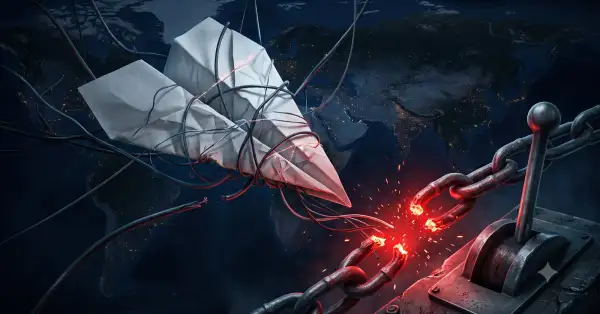
On 13 July 2026 the WHOIS record for t.me switched to the status serverHold, and every short link in the format t.me/name stopped resolving worldwide. That status is set by the operator of a domain zone, in this case the registry behind .me, and it takes the domain out of the global DNS entirely. The trigger, by the available accounts, was sanctions compliance: a t.me channel address belonging to a sanctioned service appeared on a US Treasury OFAC list, and the registry appears to have put the whole t.me domain on hold rather than a single channel.
The practical lesson was blunt. Telegram builds its links, its login flows and the on-ramp to its crypto features on top of t.me, and none of it survived a decision made by a third party in another country. Durov, by his own posts, found out about the outage from users rather than from any warning. A company whose entire public surface hangs on someone else's registry does not control its own front door.
What a .gram zone would actually give
Running your own top-level domain means you are the registry. Telegram would decide who gets a name under .gram, what stays online and what does not, without a .me or a .org operator in the middle. For users the visible part is a personal address: your username becomes a real domain, and Telegram offers to host a small site behind it. The company frames this as a website for everyone, spun up by describing what you want rather than by writing code.
Telegram applied during ICANN's 2026 round for new generic top-level domains, whose application window ran through the spring and summer. That process is slow and expensive, and approval is neither quick nor guaranteed: evaluation, objections and contention for a string can stretch over a long period before a single .gram address exists.
Does this really remove the kill switch?
Partly, and it is worth being honest about the limit. Owning the zone removes the specific weak point that failed in July, a third-party registry acting on a list Telegram had no say in. It does not put Telegram outside the system: a top-level domain still exists at ICANN's discretion and under contracts that carry their own compliance obligations, so the authority moves closer to Telegram rather than disappearing. And there is a trade-off in the other direction. Concentrating a billion personal sites inside a single company's zone, hosted on that company's servers, is a lot of the web's surface resting on one operator. That is convenient until the day the single point of failure is Telegram itself.
For the ordinary user the takeaway is not the vanity domain but the fragility it exposes. The addresses you rely on every day, for a messenger, a shop, a login, sit on top of a chain of registries and authorities you never see, and any link in that chain can pull the plug for reasons that have nothing to do with you.