UAE Bans Social Media for Under-15s - and Age Verification Is the Real Story
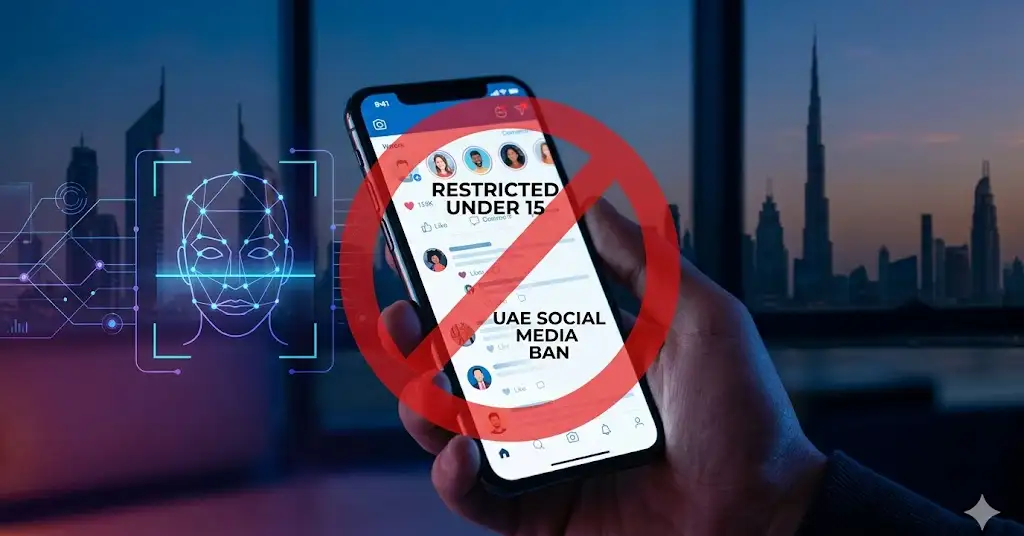
The UAE Cabinet has banned social media for all users under 15, becoming the first Arab country to join a fast-growing global movement of age-based platform restrictions. The headline is easy to miss: this is not just a ban on children using social media. It is a mandate requiring every user on every platform to prove their age - and that means biometric data collection at a scale the internet has never seen before.
What the UAE Law Actually Says
The resolution, issued June 18, 2026, creates two tiers of restriction. Children under 15 are completely prohibited from creating accounts, publishing content, commenting, or joining groups on any social media platform. The ban applies regardless of parental consent - parents cannot authorize their child to bypass it.
Users aged 15 to 16 may access platforms with restrictions: age-appropriate content filtering, blocked interaction with unknown users, time limits, and mandatory parental control tools. Platforms operating in or directed at UAE users have 12 months to bring their systems into compliance.
The key enforcement detail is the verification standard. Self-declaration of age - typing in a birthdate - is explicitly prohibited as a valid method. Platforms must implement mechanisms that verify age "with a high level of accuracy." The language points directly to document scanning and facial recognition. Non-compliant platforms face graduated sanctions: warnings, partial blocking, full blocking, and administrative fines.
The Global Picture
The UAE is not acting alone. A wave of legislation is moving through legislatures on six continents. Some countries have already enacted bans; others are weeks or months away. The table below tracks where things stand as of June 2026.
| Country | Age limit | Status | Date / timeline |
|---|---|---|---|
| Australia | Under 16 | Enacted | December 2025 |
| Indonesia | Under 16 | Enacted | March 28, 2026 |
| Malaysia | Under 16 | Enacted | June 1, 2026 |
| UAE | Under 15 | Enacted | June 2026 (12-month rollout) |
| United Kingdom | Under 16 | Announced | June 15, 2026 |
| Turkey | Under 15 | Parliament passed | Awaiting presidential sign-off |
| France | Under 15 | Proposed | September 2026 target |
| Greece | Under 15 | Proposed | January 1, 2027 |
| Norway | Under 16 | Proposed | Bill by end of 2026 |
| Spain | Under 16 | Proposed | Pending parliament |
| Denmark | Under 15 | Proposed | Mid-2026 |
| Canada | Under 16 | Proposed | Early legislative stages |
| Germany | Under 16 | Proposed | Debate stage |
| Austria | Under 14 | Proposed | Draft June 2026 |
Australia was the first to pass legislation, with its ban taking effect in December 2025. Indonesia and Malaysia followed within months. The UK announced its ban on June 15, 2026 - three days before the UAE. What was once a policy experiment is now a global standard in the making.
The Real Privacy Threat - Biometric Verification for Everyone
Here is the part that rarely makes headlines: to enforce a ban on children, platforms must verify the age of every user. There is no technical shortcut. If a platform cannot accept a user's word that they are 16, it must collect proof - and proof means documents, facial scans, or both.
This creates something new: centralized databases of biometric and identity data linked to social media accounts, held by private companies under commercial pressure to grow, held by third-party vendors whose security practices are often opaque. Malaysia's law explicitly requires government-issued ID for verification. The UAE resolution bars self-declaration and mandates "accurate mechanisms" - language that points toward the same result.
The danger is not hypothetical. Discord delayed its own age verification rollout after its verification vendor leaked 70,000 passport scans. The EU's pilot age-verification application was hacked in under two minutes at a security conference. These are not edge cases - they are previews of what happens when sensitive data is collected at scale by parties who were not built to protect it.
A stolen password can be reset. A stolen face cannot. Once biometric data is in a breach, it is in the wild permanently - and the damage compounds over time as the same data is used to authenticate across more services.
Will a VPN Help?
The honest answer is: it depends on which part of the restriction you are trying to navigate.
If a platform applies age verification only to users registering from certain IP addresses - a geo-based check at account creation - then a VPN routed through a less-restricted jurisdiction can bypass that check. This is the same mechanism that has worked for users bypassing Australia's age verification push on search engines, and for users in countries where platforms are blocked at the network level.
But if a platform implements account-level verification - requiring every account, regardless of where it was created, to submit a document or facial scan on next login - then IP masking does not help. The verification wall is inside the account, not at the border.
The trajectory of global regulation points toward the second model. Platforms with users in 14+ jurisdictions cannot maintain 14 separate verification systems forever. The economically rational move is to apply the strictest standard globally. Russia's age verification plan is already moving in this direction, with proposals to link platform accounts to national ID systems. If that model spreads, VPN use for circumvention becomes a temporary measure rather than a durable solution.
The Shadow Market Problem
Any hard restriction without a legitimate escape valve creates a market for workarounds. The UAE law explicitly bars parental consent as an exemption - a 14-year-old whose parents are willing to supervise their account cannot legally have one. That gap creates demand.
When under-age users cannot access platforms through legitimate channels, they find other routes: buying pre-verified accounts from brokers, using older siblings' credentials, or sourcing accounts through dark web marketplaces. Each of these routes exposes teenagers to fraud, phishing, and the risk of handing real identity information to anonymous sellers.
The paradox is real: a law designed to reduce harm to children online may push the most determined young users toward platforms and actors that are significantly more dangerous than TikTok or Instagram. Spain's ban and France's digital age law face the same structural problem, and neither has yet produced evidence that demand disappears when access is restricted.
• UAE sets 15 as the minimum age to use social media - The National
• UAE bans social media for children under the age of 15 - Gulf News
• UAE bans children under 15 from accessing social media platforms - Khaleej Times
• These are the countries moving to ban social media for children - TechCrunch
• UAE joins global social media crackdown on children - Gulf News
• Greece to ban social media for under-15s - Balkan Insight
• Norway wants kids to be kids with social media ban for under-16s - Bloomberg