"Internet by Passport" in Australia: How Google and Bing Now Verify User Age
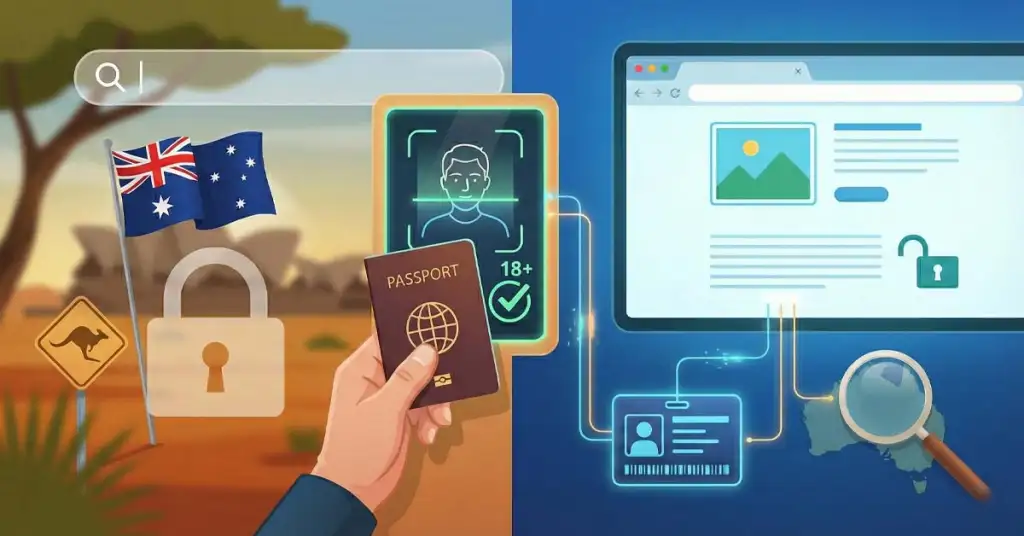
The era when the search bar was a neutral tool is becoming a thing of the past. Since December 27, 2025, Australia has officially launched a mechanism that turns Google and Bing from simple indexers into active content moderators. Now, access to information is a privilege that requires identity verification.
In this article, we will break down how the new Online Safety Code (Schedule 3) works, why you likely won't have to scan your passport every day, and whether a VPN will help bypass the system.
1. Two Classes of Users: With Passport and Without
The new regulation divides all internet users into two clear categories for which completely different rules of the game apply:
- Account Holders: If you are logged into Google or Microsoft, the system is obligated to know how old you are. If algorithms decide you are a child (under 18), a non-removable SafeSearch filter will be forced on. You will not see pornography or scenes of violence, even if you search for them intentionally.
- Anonymous (Logged-out): If you are logged out, a passport will not be required. However, the search engine will consider you a "potential child" by default. All content from categories 1C and 2 (adult content) will be automatically blurred or hidden in the search results. Want to see the image clearly? Log in and confirm your age.
2. "Inference": How Google Knows Your Age Without Documents
The most popular myth is that you now need to take a selfie with your ID for every request. In reality, IT giants will use a more subtle method — Age Inference.
Corporations analyze your digital shadow: purchase history, search queries over recent years, vocabulary in emails, and even activity times. Based on this metadata, the system assigns you a status of "Adult" or "Child" with high accuracy without a single document. Biometrics (face scan) or Digital ID will only be needed in controversial cases or to unlock very specific content.
3. The Price of Violation: Million-Dollar Fines
The regulator is serious. These are not just recommendations, but a law with harsh sanctions:
- The Timer Is On: The Code came into effect on December 27, 2025. Companies have exactly 6 months (until June 27, 2026) to fully fine-tune their systems.
- Fines: For violating filtering rules or allowing a child to access prohibited content, corporations face fines of up to 49.5 million Australian dollars per violation. This makes ignoring the law economically impossible.
4. VPN Loophole: Will It Work or Not?
Yes, using a VPN technically allows bypassing these restrictions. Since the Code only applies to users located in Australia, changing the IP address takes you out of the law's jurisdiction. Experts and even the regulators themselves admit that this will become the primary method of circumvention, especially for teenagers, as the law does not yet have mechanisms to block VPNs.
However, there is a serious threat here. Trying to avoid Google's age check, users may mass-transition to free VPN services. Research shows that such apps often collect data more aggressively than search engines or contain malware. Thus, an attempt to protect anonymity through a dubious VPN could lead to even greater loss of privacy.
• Full Code Text (Schedule 3)
• Technadu — Overview of Law Enforcement
• Compliance Hub — On VPN Bypass Risks