Spain Bans Social Media for Under-16s
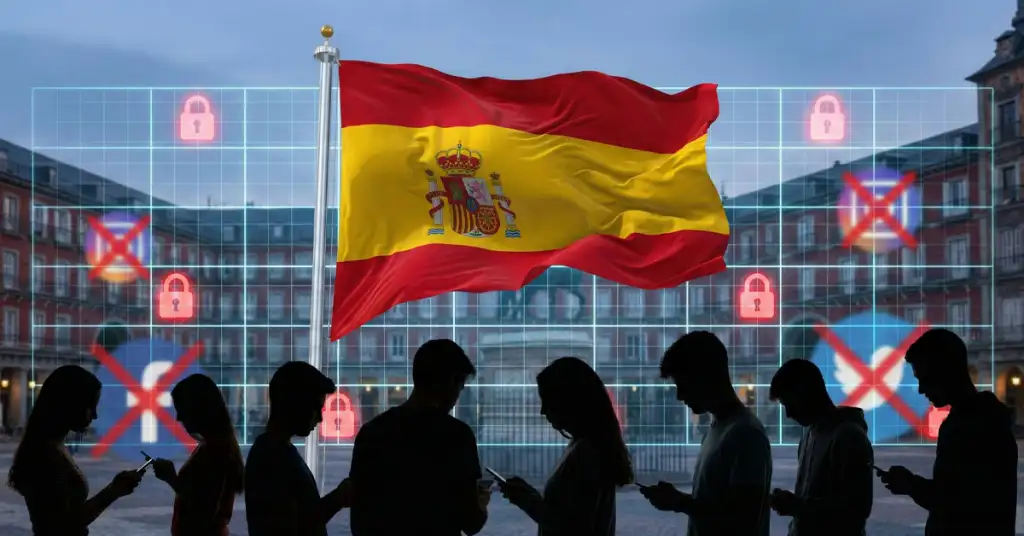
Spain officially enters the global battle for "digital adulthood." On February 3, 2026, Prime Minister Pedro Sánchez announced his intention to completely block access to social media for children and teenagers under 16. This decision places Spain alongside Australia and France, forming a new European front of strict internet regulation.
1. The End of the "Digital Wild West"
Speaking at a summit in Dubai, the Spanish Prime Minister did not mince words, calling social media a "failed state" where disinformation thrives and user rights are violated. The new bill, already dubbed one of the strictest in Europe, proposes not only fines but also criminal liability for executives of tech platforms that fail to enforce the age limit.
The key difference between the Spanish approach and the French one (where the bar is set at 15 years) is the strictness of verification. Sánchez demands that IT giants implement "real barriers," not simple "I am 18" checkboxes that any teenager can bypass in a second.
2. Domino Effect: Who's Next?
The IT world is observing a rapid chain reaction. While the internet was previously considered a borderless space, every country is now building its own "digital fence":
- Australia: First in the world to introduce a complete ban for those under 16 (end of 2025).
- France: In January 2026, approved a ban for those under 15 and a smartphone ban in high schools.
- Spain: Preparing a ban up to 16 years with identity verification requirements.
3. Will a VPN Help Bypass the Ban in Spain?
For VPN service users, this law creates an interesting technical conflict. Usually, a VPN is used to change virtual location (IP address) to access content from another country.
However, if the Spanish law obliges platforms (Instagram, TikTok, X) to verify documents (digital ID) upon registration of every new user, changing the IP address might prove useless for locals. A Spanish teenager would not only have to turn on a VPN but also find a way to verify the account as a "citizen of another country."
This changes the very model of VPN usage: from a tool of anonymity, it turns into a tool of "digital emigration." To sign up for a social network, a user will have to simulate being entirely within a jurisdiction where such bans do not exist (e.g., in the USA or Latin American countries).