The EU Signed Off on Its Own Satellite Network. It Is Not a Starlink for Citizens
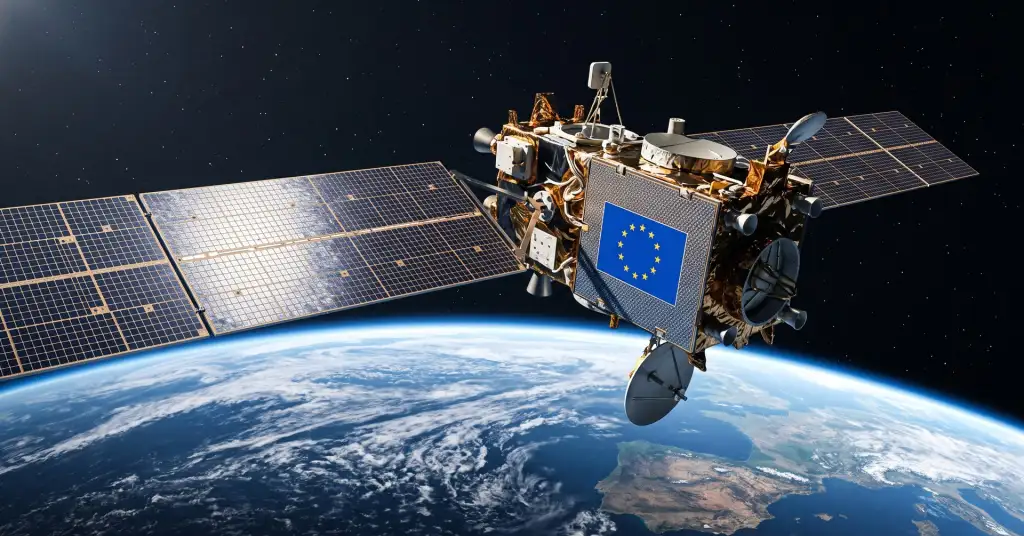
On 7 August the European Commission and the SpaceRISE consortium signed the implementation agreement for IRIS2, the European Union's own satellite constellation. The plan grew by 66 spacecraft to 348 in total, and the first launches were pulled forward to 2029. Coverage has been calling it a European Starlink. That label is where the useful part gets lost, because the two systems are built for different people.
What was actually agreed
IRIS2 stands for Infrastructure for Resilience, Interconnectivity and Security by Satellite. The signed architecture is 348 satellites: 330 in low Earth orbit and 18 in medium Earth orbit. The 66 added spacecraft form a dedicated layer for defence, security and emergency services, and the Commission expects the revised design to deliver 60 percent more secure governmental capacity inside the EU and 54 percent more worldwide.
SpaceRISE is a consortium of the satellite operators SES, Eutelsat and Hispasat. The European Space Agency oversees development, qualification and in-orbit validation. Funding comes from the EU budget for 2028 to 2034 together with member state and third country money, with several countries naming their own contributions. First launches are targeted for 2029, with services phased in from that point and full capability expected around 2030.
Why the Starlink comparison misleads
Starlink was built consumer first: you buy a terminal, you get broadband, and governments became customers later. IRIS2 is the other way round. Its priority users are EU public authorities, defence and security forces, emergency services and critical infrastructure operators. There is a commercial layer, and it is meant to reach citizens and businesses through operators, but it sits behind the governmental one in both design and guarantee of availability.
That is not a criticism of the project, it is what it was commissioned to be. But it changes the answer to the question our readers actually have, which is whether this will help someone whose government has just switched the internet off.
The part that does matter for shutdowns
Satellite access is genuinely the last route out of a national blackout, because it does not travel through the local operators a government can order to stop. We have seen what the alternative looks like when Iran cut the country off during mass unrest, and why people fall back on offline mesh communication when the network is gone.
But a constellation does not remove the political question, it relocates it. Someone still decides whether to serve a given country, and terminals still have to cross a border and be legal to own. The relevant change in IRIS2 is not capacity, it is who holds that decision: a European public programme rather than one company answering to one owner. Whether that turns out better for people under a shutdown depends entirely on choices the EU has not made yet.
What satellite access actually requires
It is worth being concrete, because satellite connectivity is often discussed as if the hardware appeared by itself. Four things have to line up, and a constellation only supplies the first:
- Coverage that is switched on for your country. An operator decides this, and the decision is commercial and political, not technical.
- A terminal in your hands. It has to be bought and physically brought in. States that cut the internet also tend to ban importing or owning the equipment.
- Power. Shutdowns often arrive alongside outages, and a dish plus router needs a supply that outlasts them.
- Acceptable risk. An antenna pointed at the sky is visible, and its transmissions can be located. That is a different threat model from installing an app.
This is also where the limits of everyday tools are worth stating plainly. A VPN routes around blocking, and it is the right tool while the network is up. It does nothing when there is no network at all, and satellite is the layer below it. The two solve different halves of the same problem.
Conclusion
• The European Union is accelerating and reinforcing IRIS2 - European Commission
• IRIS2 reinforced and accelerated as implementation advances - ESA
• Commission accelerates IRIS2 deployment with enhanced security and expanded satellites network - SES
• IRIS2 - Secure connectivity - EU Space Programme