Starlink starts cutting off South Africans on foreign roaming accounts
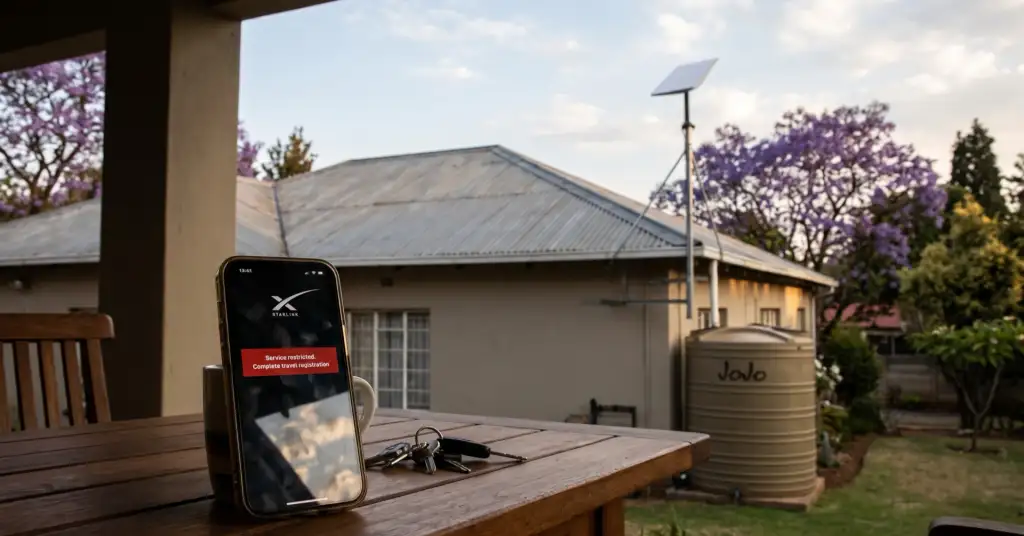
Starlink has started cutting off South Africans who use the service on roaming accounts registered in other countries. On Friday, 23 October, users reported a message on their terminals: "You're using your Starlink outside your account country. Complete travel registration to restore service." South African technology site MyBroadband first reported the restrictions.
Starlink has no licence to sell its service in South Africa. Since early 2023, people there have used imported dishes registered in countries where Starlink is sold, and connected through roaming plans. To keep using them, they now have to register as travellers and hand over identity documents.
What Starlink's travel registration asks for
Starlink requires travel registration for any use outside the country where an account was first registered, on every plan except Enterprise. According to the Starlink help page quoted by ISPreview, a customer has to give their full legal name, nationality, date of birth, passport number, a copy of the passport and a live portrait photo. If registration is incomplete, Starlink disables the service in that country.
For someone who lives in South Africa this is more than paperwork. Starlink's terms describe roaming as temporary use by international travellers, so a South African resident who registers with a local passport is, in effect, telling the company that the dish is not travelling. MyBroadband notes that the restriction comes from Starlink's own compliance terms and not from an order by the regulator. Starlink has not commented publicly, and it is not known how many users have been cut off.
The check does not rely on IP addresses. Starlink dishes have a built-in GPS receiver, and the service compares where a terminal actually is with the country on the account. A VPN on the router or a laptop changes the address that websites see, but the dish still reports its real position, so it does not help here.
How the roaming squeeze got here
The restrictions have tightened step by step. Imported dishes on foreign accounts first worked without limits. In mid-2024 Starlink introduced a 60-day limit on continuous use outside the home country, later cut to 30 days and, for some South African users, to seven. In June 2025 Starlink suspended access for some South Africans on roaming plans. In neighbouring Namibia, it blocked service completely after legal demands from local authorities.
Demand has not gone away. MyBroadband recorded 2,232 Starlink speed tests in South Africa in August 2026, the highest monthly figure it has seen.
Why Starlink is still not licensed in South Africa
South African rules require holders of individual telecom licences to be 30% owned by historically disadvantaged groups. SpaceX does not want to sell a stake in a local subsidiary and has offered investment commitments instead. Communications Minister Solly Malatsi supports letting operators meet empowerment goals through such equity-equivalent programmes, but the regulator, ICASA, runs the licensing process and the legal framework would have to change first. In May 2025 ICASA said it was investigating whether Starlink was operating in the country without authorisation.
It is not the first time SpaceX has changed overnight who can use the network: earlier this month it restricted Ukrainian military terminals moving faster than about 160 km/h, without warning. South African users on foreign accounts now have to choose between registering with a passport under terms written for travellers and going without Starlink until it gets a local licence.