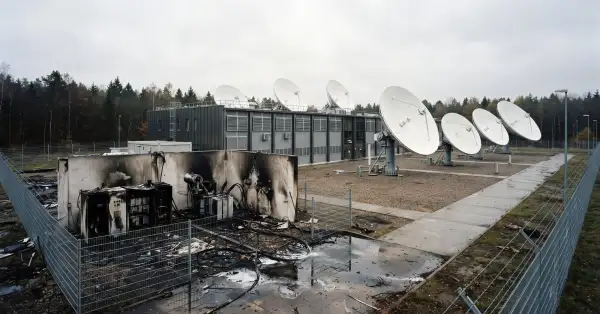
Strikes on Kyiv data centres left about 100,000 homes without internet

On Wednesday 23 September a Russian drone attack on Kyiv damaged buildings housing data centres and backbone network equipment, and about 100,000 households in the city and the surrounding region lost their fixed internet connection. Ukraine's Ministry of Digital Transformation gave the figure while repair crews were still assessing the damage. The monitoring group NetBlocks recorded partial connectivity losses at four providers: Kyiv Link, Pautina, Utels and Crazy Network.
This is the scenario where the usual privacy toolkit has nothing to offer. A VPN reroutes traffic; it cannot recreate a path that no longer exists physically. When the equipment is gone, the only thing that helps is a second, independent way of reaching the network, and that has to be arranged before the day it is needed.
In short
- Around 100,000 households in Kyiv and the region lost fixed internet after the 23 September attack.
- Pautina said several of its sites were hit and nearly half its network temporarily went down.
- Crazy Network reported a strike on a central traffic exchange facility, with outages reaching Vinnytsia and Khmelnytskyi.
- People in the industry say individual strikes cannot switch off Ukraine's internet, because the network is deliberately decentralised.
What was hit and who went dark
An office building in Kyiv's Solomianskyi district was damaged by a Geran-5 jet-powered attack drone. It housed a data centre and key communications and backbone nodes serving the city. Utels said one Kyiv data centre holding its core network equipment was damaged and lost power, and that it restored service to most customers within roughly two hours. Pautina reported the heaviest damage: several infrastructure sites hit, critical equipment and communication lines destroyed, and nearly half of its network temporarily out. Crazy Network described a strike on a central internet traffic exchange facility, which took down internet and telephone service for customers in Kyiv and in the Vinnytsia and Khmelnytskyi regions.
The effects ran past the consumer providers. Etherlink told its support chat on 24 September that an attack had damaged its main network node and that there was no internet as a result; the core of its network would be moved elsewhere and the company was still looking for a location, so it named no restoration date. The hosting company MiroHost said the Ukrainian data centre holding its infrastructure was destroyed, although its founder told dev.ua that 90 to 95% of its customers run on infrastructure outside Ukraine and were unaffected. CityHost said equipment it kept in a Kyiv data centre was destroyed. Wednesday's strikes on the city also killed two people and injured at least 43, and damaged homes, railway infrastructure and a historic market.
Two accounts of the same night
Russia's Defence Ministry claimed its forces had struck two Kyiv data centres, New-Telco and United DC, asserting that the facilities served Ukraine's defence ministry and its intelligence and security agencies. Those claims could not be independently verified, and Ukrainian authorities have not confirmed that the two facilities were hit at all.
Ukraine's foreign minister Andrii Sybiha put it the other way round: the targets were civilian, and the point of hitting them is the information they carry. "This is critical civilian infrastructure that ensures people can access life-saving information. It is not a military target. It is essential to keeping everyday life functioning," he said, noting that connectivity is what delivers air-raid warnings in time. The owner of Utels, Oleksandr Poliudov, told Forbes that three data centres were hit that day and declined to name them for security reasons, calling it one of the largest attacks on telecom infrastructure since July.
How much was actually destroyed
Four key data centres were hit in that attack, and the damage varies enormously between them. "For the first time we have a situation like this: water got into one data centre, it flooded a little, and because of that almost everything there is destroyed. At the second only the diesel generator suffered. The third stayed practically intact. At the fourth the problems were purely with the power supply. So in most cases the physical infrastructure was not critically destroyed," said Anatolii Frolenkov of the 1-IX exchange point.
The sites mattered because they were switching hubs for a substantial share of the country's internal traffic, and two large operators whose network core sat there went down for several hours. What stopped it from becoming worse was preparation: operators and hosting firms deployed on backup sites and rebalanced traffic within roughly two hours, and most data centre customers barely noticed, because after 2022 everyone learned to spread servers between different Kyiv facilities and European ones. Across 23 and 24 September the strikes damaged data centres and network infrastructure belonging to at least nine providers and hosting companies.
Why this does not switch off Ukraine
The industry reaction was notably unpanicked, and the reason is structural. Oleksandr Hlushchenko, formerly on the board of the Internet Association of Ukraine, said striking individual data centres cannot take down the country's fixed internet, because the network is decentralised: Ukraine has extensive optical infrastructure, and providers spent the war years building additional channels and backup sites. A former member of the government team responsible for telecoms put it in numbers, estimating that about 90% of the industry's infrastructure is now prepared for this kind of attack, with key nodes duplicated and backup channels in place.
What experts recommend next is more of the same, only harder to fund: spreading backup capacity across other data centres, western regions or other countries, and physically protecting the critical nodes. Vodafone Ukraine is working on underground data centre capacity, which it frames as a long-term investment in the resilience of the digital economy. Underground construction takes years, so the faster answer stays the boring one, duplicating critical nodes and mirroring infrastructure elsewhere. The same week made the point from another direction, when a fire at a Starlink ground station in Poland that carries traffic to Ukraine was treated by Polish authorities as arson.
Resilience also has a price, and it is about to appear on bills. Oleksandr Poliudov, who owns Utels, said providers that keep backup power and backup communication channels cannot go on selling internet at 300 to 350 hryvnia a month, and that a significant increase is coming. Companies unable to invest in their own resilience, he added, may simply not survive the competition.
The one case where a VPN is the wrong tool
It is worth being exact about this, because the reflex in any connectivity story is to reach for a tunnel. A VPN changes the route your traffic takes and who can read it along the way. It cannot conjure a route where the fibre, the switch or the building has been destroyed, and it cannot help if your provider's core equipment has no power. In a physical outage the tunnel fails for the same reason the browser does.
What does work is redundancy that does not share the broken part: a mobile connection when the fixed line dies, a satellite terminal when the local ground infrastructure dies, and a way to talk to people nearby when everything upstream dies. Each of those is a separate decision, and each is cheapest to make while the network is still up.
What keeps you reachable when the cable is gone
The last layer is the one most people never set up, and it is the one that works when there is no network at all. Phones can talk to each other directly over Bluetooth and Wi-Fi, passing messages hop by hop between devices, which is enough for a courtyard, a shelter or a street. We went through how that works and what it costs in our guide to offline mesh communication during a shutdown, and the best known app of that kind became a legal target in its own right when India demanded GitHub remove Bitchat, a messenger that works without the internet.
- Run two fixed connections if you can, and keep SIM cards from two different mobile operators
- Combine a small local provider with a large national one: the small one sends a repair crew faster, the big one can afford real backup capacity
- If you want to go deeper, check your provider's connectivity: how many Tier-1 and Tier-2 upstreams it buys and how many exchange points it sits in, because more of both means fewer single points of failure
- Install an offline mesh messenger now and pair it with the people you would actually need to reach, because you cannot download it later
- Save offline what you would need without a network: documents, a map of your area, emergency numbers, and keep a power bank charged
Would a VPN have kept these households online?
Can strikes take Ukraine's internet down entirely?
Which data centres were destroyed?
Does satellite internet solve this?
What is a mesh messenger?
• Kyiv internet providers report major outages after Russian attacks damage data centers - The Record
• Russia puts Ukraine's internet in its sights as attacks on Kyiv infrastructure intensify - The Kyiv Independent
• The Russians hit three data centers in Kyiv yesterday. Why it won't work to shut down the entire internet with strikes - dev.ua
• Almost 100,000 households in Kyiv and the region remain without the Internet - dev.ua
• Four data centres in Kyiv hit at once: what it means for consumers - dev.ua
• Etherlink reports damage to its main network node after the Russian attack - Forbes.ua
• Russians target Kyiv data centres: what Ukrainians should expect - Espreso
• Kyiv Faces Internet Disruptions as Russian Strikes Hit Data Centers and Communications Infrastructure - UNITED24 Media