Youth festival in Yekaterinburg gives foreign guests Wi-Fi without Russian blocks and keeps Russians out of it by badge number
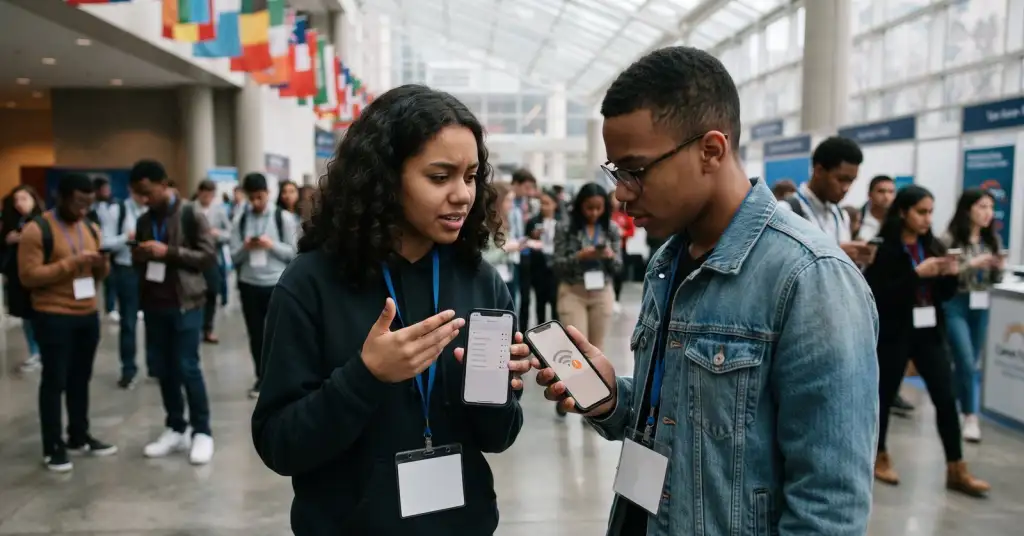
At the International Festival of Youth in Yekaterinburg, the Wi-Fi comes in two versions. The printed guide handed to participants lists the network IWYF2026_UNITED for "Russian guests" and IWYF2026_GLOBAL for "foreign guests", and on the second one, according to the Urals outlet Signal Ural and the news site Uralweb, Instagram, Facebook and the rest of the sites Roskomnadzor blocks open without a VPN. Access is tied to the accreditation badge: to join any network you type in your badge number, and the system refuses to let a Russian citizen onto the foreign one. Ten thousand young people from 191 countries are at the festival, half of them Russian, and for six days the country's internet censorship has been switched on and off according to what their passport says.
In brief
- Three wireless networks with different access rights run at the Yekaterinburg-Expo venue, Uralweb reported on 15 September; the badge number is the login, and it decides which internet you get.
- Signal Ural published a photo of the participant guide, where the two SSIDs, one for Russians and one for foreigners, are printed side by side under the Wi-Fi logo, just below the hotline numbers.
- The infrastructure was built by Rostelecom, the state carrier: more than 500 access points, 60 kilometres of new cable, coverage at the Expo, the aquatics palace, the airport, the railway station and the university campus.
- It is the cleanest demonstration yet of what the blocking system is: a filter applied to people, not to content. The same state that now blocks whole hosting subnets to stop VPN apps can lift every block for a chosen group with a badge database.
What the participants found
The festival opened on 11 September with 10,000 participants, 5,000 from Russia and 5,000 from abroad, and the local press had already praised the digital preparations. Rostelecom, in a statement carried by URA.RU, described the channels, Wi-Fi, radio communications, IP telephony, video surveillance and "round-the-clock information protection" it had set up across the venues, with 500 access points and 60 kilometres of cable so that guests could "share photos and news and communicate on social networks". The part it did not describe surfaced on Monday morning. "Russia, a generous soul," Signal Ural wrote at 10:49 Yekaterinburg time above the photo of the guide: "Foreigners at the Youth Festival in Yekaterinburg have been allowed to use the banned social networks. Three kinds of Wi-Fi work at the forum." Uralweb, citing the same outlet, added the mechanism: three networks with separate rights at the exhibition complex, authorisation by personal badge number, and a system that "does not allow citizens of Russia to connect to the foreign internet network". On foreign participants' devices, it said, "social networks and internet resources banned in Russia open without using a VPN". Everyone, the site noted, could attend Steven Seagal's lecture on the cultural code without restrictions.
Why a badge can do what a VPN is punished for
Technically there is nothing exotic here. A captive portal checks the badge number against the accreditation database, puts Russian passport holders in one VLAN and everyone else in another, and the foreign VLAN either bypasses the operator's filtering equipment or goes out through a route where the TSPU boxes Roskomnadzor installs at every carrier are not applied. Rostelecom knows how to do both; it is the carrier that runs the filtering for most of the country. What is new is not the engineering but the admission it contains. For years the official line has been that the blocks protect Russians from extremist content, foreign interference and fraud. A festival where the protection is lifted for anyone holding a foreign passport, while a Russian participant sitting at the next table is kept behind the wall, says the blocks are not about the content. They are about who is looking at it. The same message came from the other direction in August, when the regulator asked Russian apps to detect VPN use and report it: the target of the system is the citizen who tries to see what the guest is shown for free.
The wider pattern
Two-tier access is not a Yekaterinburg invention. Chinese hotels and conference centres have for years offered foreign guests connections that bypass the Great Firewall, and Russia itself experimented with "white lists" during the mobile-internet shutdowns of 2025, when only a short list of domestic services stayed reachable and everything else, including VPNs, went dark. The festival network inverts that idea: an allow-list of people rather than of sites. It is worth remembering the next time a block is explained as a technical necessity or a security measure. The equipment that enforces it is the same equipment that lifted it this week for anyone with a foreign badge, and the criterion was a number printed on a lanyard. For Russians, the practical lesson is old and has just been illustrated in the clearest possible way: the internet the rest of the world uses still exists, one network name away, and the only thing between them and it is a policy decision, which is what a VPN is for.
What exactly did foreigners at the festival get?
How does the network know who is Russian?
Who built the network?
Is this legal?
Has this happened at other events?
• На фестивале молодёжи в Екатеринбурге иностранцам разрешили пользоваться соцсетями без ограничений РКН - Uralweb
• Россия - щедрая душа: иностранцам на Фестивале молодежи разрешили пользоваться запрещёнными соцсетями (фото гида участника) - Сигнал Урал
• Wi-Fi, 60 км сетей и лестница в небо: «Ростелеком» обеспечит цифровыми сервисами фестиваль молодежи - URA.RU
• В Екатеринбурге проходит Международный фестиваль молодежи: 10 000 участников из 191 страны - 7Дней.ру