India ties its cooking gas subsidy to Aadhaar biometrics from 1 October
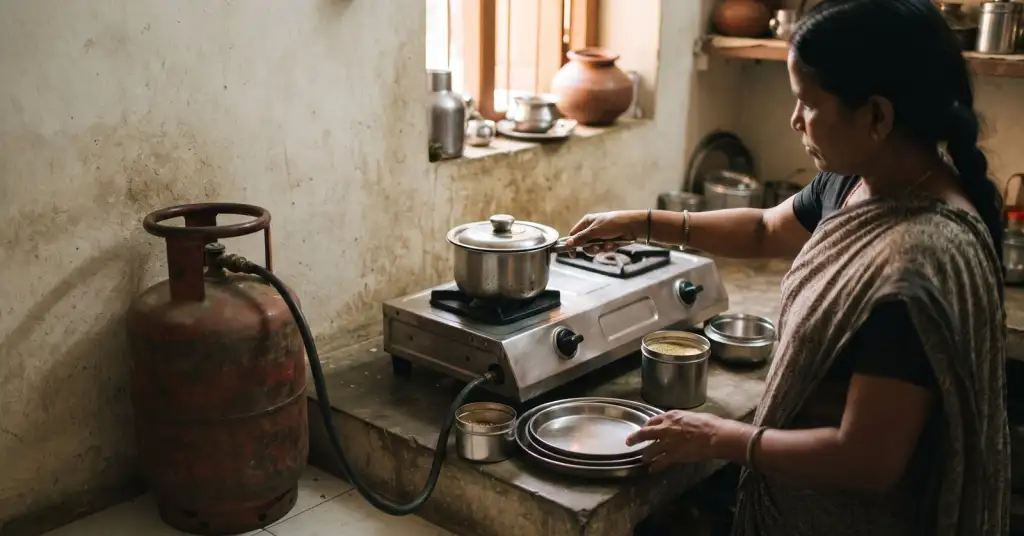
From 1 October India will only sell subsidised cooking gas to households that have passed Biometric Aadhaar Authentication. A fingerprint, an iris scan or a face scan now stands between a family and the regulated price of a gas cylinder, the fuel most Indian kitchens run on. The petroleum ministry says 27.43 crore consumers, 89.9% of active domestic connections, have already done it.
The other 10.1% is where the story is. That is roughly 3 crore connections, some 31 million households, and after 1 October they keep their gas but lose the subsidy. Officially nobody is cut off. In practice a biometric check has become the condition for a basic household benefit in a country where the same biometric has been failing for a decade.
In short
- From 1 October a refill at the regulated price requires completed Aadhaar biometric authentication.
- 27.43 crore consumers, 89.9%, are done. The rest keep buying gas, at market price.
- Those who opt out are moved to 5 kg or 10 kg cylinders, subject to local availability, instead of the standard 14.2 kg one.
- India's own auditor found fingerprint authentication succeeding in about three attempts out of four, and 5,69,196 people with no usable biometrics at all.
What changes on 1 October
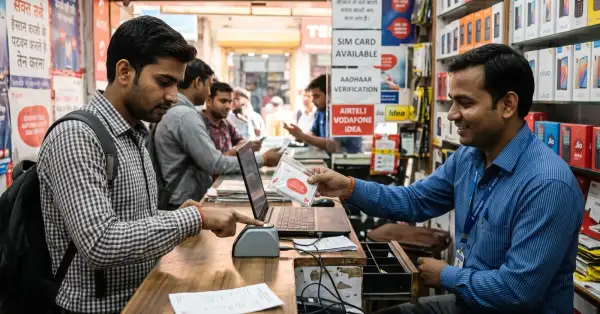
The rule itself is narrow. If you have completed Biometric Aadhaar Authentication, nothing changes and refills continue as before. If you have not, booking at the regulated retail selling price with the subsidy switches back on the moment you complete it, so the door is not locked, it is just closed. Authentication is free and can be done three ways: the delivery person can do it on the doorstep through the oil company's app, a distributor can do it at the showroom, or you can do it yourself at home with the company app plus the Aadhaar FaceRD app, which scans your face instead of your fingerprint.
There is also a formal way out, and it is the detail worth reading twice. A consumer who is unwilling or unable to authenticate has to register that choice through the oil company's web portal, app, WhatsApp chatbot or phone menu. After that they are supplied gas at market price without subsidy, in 5 kg or 10 kg cylinders, subject to local availability. Declining the biometric costs money and also changes what you are allowed to buy, leaving you at the mercy of whatever the local depot happens to stock.
Seven deadlines came and went first
This is not a sudden order. Consumers were first told to authenticate by 30 June 2026, and the date then moved to 31 July, 7 August, 15 August, 23 August, 31 August, 7 September and finally 14 September, before the ministry settled on 1 October as the day the subsidy actually depends on it. Since October 2023 the oil companies have sent more than 12 crore SMS and WhatsApp messages, run camps at distributorships and in rural areas, and had delivery staff chase individual households.
- Oil companies start the nationwide authentication drive.
- The first deadline for completing biometric authentication.
- Five more deadlines: 31 July, 7, 15, 23 and 31 August.
- The last of the extended deadlines passes.
- The ministry announces the rule and reports 89.9% coverage.
- The subsidy starts depending on the biometric check.
Why the government wants it
The stated reasons are not unreasonable. Tying each connection to an authenticated person is meant to stop subsidised domestic cylinders being resold to restaurants and workshops, and to clear duplicate and ineligible connections out of the register. The money behind it is real: domestic gas is sold below cost, the implicit subsidy was around ₹210 per 14.2 kg cylinder in September 2026 and reached ₹721 in June, the government paid the oil companies ₹22,000 crore in 2022-23 and is paying ₹30,000 crore across 2025-26 and 2026-27, and accumulated under-recoveries still passed ₹62,000 crore by the end of August. A subsidy that leaks is a subsidy that eventually gets cut.
For the poorest households the stakes are specific. Under the Ujjwala scheme a beneficiary gets ₹300 off a cylinder, and the biometric check has to be repeated once a financial year to keep the eighth and ninth refills subsidised. Miss it and the subsidy pauses rather than vanishes: the arrears are released once the check is completed before the financial year ends.
The part where the fingerprint does not work
India's own auditor has already documented what happens when a welfare system leans on fingerprints. In its 2021 report on the Aadhaar authority, the Comptroller and Auditor General recorded UIDAI's own explanation that most authentication is fingerprint-based and that fingerprints "do change in adults with time based on their job profiles". UIDAI told the auditor that transaction-wise fingerprint authentication success had improved from 70-72% in 2016-17 to 74-76% in 2019-20. Read that the other way round: around one attempt in four was failing, and the improvement over three years was four percentage points.
The same audit lists 5,69,196 residents in the "100 per cent biometric exception" category, people whose biometrics cannot be captured usefully at all. It notes that the fee for a voluntary biometric update was raised from ₹50 to ₹100, so a person whose prints were badly captured pays to have them fixed. And it records that UIDAI, asked why authentication fails, said it could not ascertain the reasons, because it does not receive location data and had not analysed state-wise failures. The one place the audit found state figures was an Economic Survey estimate quoted in the report: 49% failure in Jharkhand, 37% in Rajasthan, 6% in Gujarat, 5% in one district of Andhra Pradesh.
How many people in India are registered in the "100 per cent biometric exception" category, meaning no usable fingerprints or iris at all?
The figure comes from the Comptroller and Auditor General's 2021 audit of UIDAI. These are people for whom a biometric gate cannot work by design, whatever the policy says.
"Voluntary" has a narrow legal meaning here
Section 7 of the Aadhaar Act is what makes this lawful. It lets the government require authentication or proof of an Aadhaar number as a condition of receiving a subsidy paid out of public funds, and it carries a proviso: "if an Aadhaar number is not assigned to an individual, the individual shall be offered alternate and viable means of identification for delivery of the subsidy, benefit or service." The protection is written for people who do not have an Aadhaar number. It says nothing about the person who has one and whose fingerprints will not read.
That gap is the whole argument. As recently as July 2024 a minister told Parliament that no service or benefit had been stopped over incomplete biometric authentication, and officials described the process as encouraged rather than required. Two years later the subsidy depends on it. Nothing here is illegal, and nobody is formally denied gas. The system simply arranges things so that the identity check is the only affordable path, which is how a voluntary ID becomes a compulsory one without a law ever saying so. India has run the same play before, when it made biometrics a condition for getting a SIM card.
Why this matters outside India
Aadhaar is the largest identity system on earth, which makes it the reference design everyone else studies. The mechanism being tested here is not "show your ID" but "prove your body matches the record, every time, or pay more", and it is being applied to cooking fuel rather than to a bank account or a border crossing. The same shape is turning up elsewhere under different names, from age checks that quietly become identity checks to date-of-birth requirements on messengers. The lesson from the audit is not that biometrics never work. It is that they fail unevenly, they fail most often for people who do manual work, and the failure lands on the person, not on the system.
If you are in India and have not authenticated
The process costs nothing and does not require a trip to an office.
- At the door: ask the delivery person to complete it during your next refill, using the oil company's app.
- At the distributor: walk into the showroom of your Indane, Bharatgas or HP Gas distributor.
- From home: install your company's app, IndianOil ONE, HelloBPCL or HP PAY, together with the Aadhaar FaceRD app, and complete the face-based check yourself. Tutorials sit on the PMUY portal.
- If you will not do it: register that choice on the company's portal, app, WhatsApp chatbot or phone menu, and expect market price and smaller cylinders.
- If it fails: the LPG helpline is 1800 2333 555, and an authentication completed later switches the subsidy back on.
Will gas stop coming if I do not authenticate?
Is it too late after 1 October?
What if my fingerprints do not scan?
Is Aadhaar not supposed to be voluntary?
How many people are actually affected?
• Biometric Aadhaar Authentication Mandatory for Subsidised Domestic LPG Refills from 1 October 2026 - Ministry of Petroleum & Natural Gas, PIB
• Govt mandates Aadhaar biometric authentication for LPG subsidy from Oct 1 - Business Standard
• LPG Aadhaar e-KYC: October 1 deadline for subsidised refills - The Tribune
• Govt Repeatedly Said Aadhaar Wasn't Compulsory for LPG, Now it is Pushing it Aggressively - The Wire
• Enrolment, Update and Authentication Ecosystem, Report No. 24 of 2021 - Comptroller and Auditor General of India
• The Aadhaar Act 2016 as amended, Section 7 - UIDAI
• High rates of Aadhaar biometric verification failure leads to UIDAI scrutiny - Biometric Update