The Age Gate Reaches WhatsApp: India Is Asking for Your Date of Birth
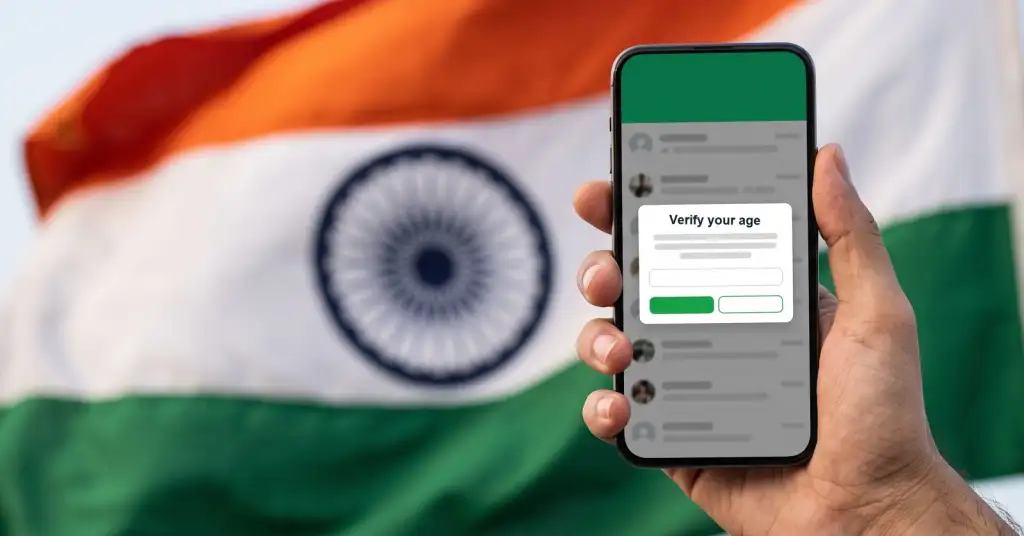
Age verification has spent two years arriving at websites, app stores and operating systems. In August 2026 it reached a messenger. WhatsApp users in India began seeing a prompt asking them to add their date of birth, with the explanation that upcoming Indian laws require the platform to establish how old they are. The field is optional today. The reason it exists is not.
What the WhatsApp Age Verification Test in India Actually Shows
Screenshots of the prompt started circulating in the first days of August, and Meta confirmed the test. Its statement is short and worth reading closely: to comply with upcoming laws in India like the Digital Personal Data Protection Act, the company said, it is testing privacy-protective ways for people to confirm their age. WhatsApp has also said the date of birth will not be shown to other users.
Two limits are real and should not be overstated. Nobody has to fill it in: users who ignore the prompt keep using the app as before. And it is a test on a limited set of users, not a rollout. India is nevertheless the largest market WhatsApp has, reported at more than 600 million users; Meta does not publish country-level figures, so every number in circulation is an outside estimate, but the order of magnitude is not in dispute.
What the DPDP Rules Require, and When
The DPDP Act, India's Digital Personal Data Protection Act, treats anyone under 18 as a child. The rules that operationalise it were notified in November 2025 and phase in over roughly eighteen months, with full compliance due in May 2027. For children they require something specific: verifiable consent from a parent or guardian before a platform processes a child's data, and a prohibition on behavioural tracking and targeted advertising aimed at children.
Notice what that does and does not say. The law does not order every Indian to prove their age. It orders platforms to obtain parental consent for children and to exercise due diligence in establishing who the children are. That distinction sounds academic until you are the platform: to know which accounts need parental consent, you have to form a view about every account. The legal duty falls on children, and the practical consequence lands on all 600 million.
Why a Self-Declared Birth Date Is Not Verification
A text field that anyone can type anything into verifies nothing. A fifteen-year-old who wants an account will enter a year that makes them nineteen, exactly as teenagers have done at every gate ever built. In its current form the feature is a declaration, not a check, and as a compliance artefact it mostly demonstrates that the company asked.
Which is why the current form is unlikely to be the final one. If a self-declared date satisfies due diligence, the whole exercise is paperwork. If it does not, then something has to confirm the answer, and the options are the ones already familiar from other countries: a document scan, a face estimate, a payment card, or a link to a government identity system. In India that last option has a name and a billion enrolments. To be clear, neither Meta nor the regulator has proposed routing this through Aadhaar, and nothing announced points that way; it is simply the option the country already has built, and if age assurance in a messenger ever reached it, an anonymous account would stop being possible.
The Accounts Under Review
Alongside the prompt, some users reported a second and less explicable message: a notice that their account was in review, with a date attached. WhatsApp acknowledged the reports but did not say what triggered the reviews or which regions were affected, and no link to the age test has been established. It may be unrelated. It is worth recording because it is the part users found alarming, and because unexplained account reviews arriving in the same week as an age prompt is the kind of coincidence that deserves an answer rather than a shrug.
Why the Messenger Is the Line That Matters
Age checks on a pornography site are one argument. Age checks on a social network are another. A messenger is a third thing entirely, because for hundreds of millions of people it is not a service they visit, it is how they are reachable at all: family, work, school groups, small businesses, and in India a great deal of government and banking communication. A gate on that is a gate on ordinary life, and the case for it has to be correspondingly stronger.
This is also the point at which the pattern stops being a national story. The same logic produced the state laws now under scrutiny in the United States, where an investigation traced five British organisations through 42 age verification bills, and it is the mechanism catalogued in our list of countries restricting social media by age. India is not copying anyone. It is arriving at the same place from its own direction, which is a stronger signal than imitation would be.
What Users Can Do Now
- You are not required to fill it in yet: during the test the prompt can be dismissed and the app keeps working. Providing data early to a system whose final shape is undecided buys you nothing.
- Do not treat a date of birth as harmless: combined with a phone number it is one of the two fields that make identity theft and convincing phishing possible, and unlike a password it cannot be changed after a breach.
- Watch what the prompt turns into: the meaningful moment is not this optional field, it is the first version that refuses to let you past. That is when the question of what proof is accepted becomes real.
- Keep a channel that does not depend on one company: if your only reachable identity is a single messenger account, any rule about that account is a rule about you.
- Be honest about what a VPN does here: nothing. This is an account-level prompt tied to the market you are in and the number you registered with, not to your IP address. Where a VPN still helps is everything around it, hiding traffic from the network and shrinking what an ISP or a public Wi-Fi operator learns, and that is worth separating from a claim it cannot deliver.
Conclusion
• WhatsApp Tests Age Verification; Some Users Report Accounts Under Review - Inc42
• WhatsApp tests age verification feature in India ahead of DPDP Act rollout - Storyboard18
• WhatsApp Tests Optional Date Of Birth Feature In India Ahead Of DPDP Act Age Verification Rules - Free Press Journal