India Orders GitHub to Remove Bitchat, the App That Works Without Internet
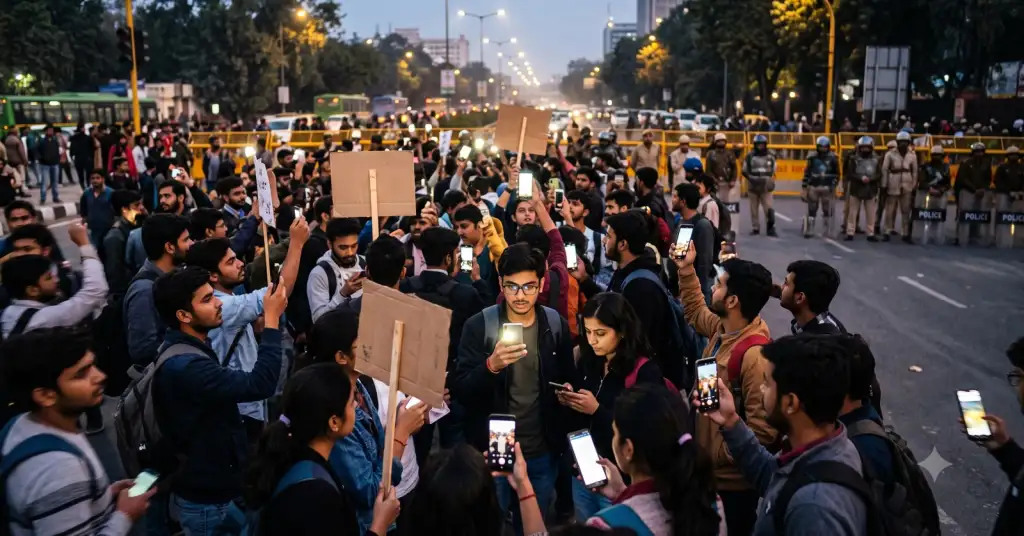
India has ordered GitHub to remove Bitchat, an open-source messenger that works without the internet, and gave the platform three hours to comply. The notice was issued late on 23 July 2026 by the Indian Cyber Crime Coordination Centre (I4C) under the Ministry of Home Affairs, after students protesting an exam paper leak in New Delhi began using the app to stay in touch through repeated mobile internet shutdowns. It is one of the first times a government has demanded the deletion of software not for anything published with it, but for what the software is technically able to do.
A three-hour ultimatum to GitHub
Notice No. 11072601011432 was sent at 11:16 pm on 23 July and named three repositories under the "permissionlesstech" account: the main Bitchat project, the Android build, and the Android release page. I4C invoked Section 79(3)(b) of the Information Technology Act, 2000, read with Rule 3(1)(d) of the IT Rules, 2021. That combination is an intermediary liability provision: if GitHub fails to act, it does not get fined directly, it loses safe harbour and becomes legally answerable for what its users host.
The reasoning in the notice is unusually explicit. The ministry argued that Bitchat lets people communicate "even during network restrictions" and can "circumvent lawful restrictions" during internet shutdowns, which in turn hampers "lawful interception, attribution, and traceability" and creates risks to the sovereignty and integrity of India, public order and national security. Jack Dorsey, who backed the project, summed it up on X: the government of India does not like technologies like Bitchat and wants it taken down.
Why Bitchat cannot simply be blocked
Bitchat is a Bluetooth mesh messenger. It needs no SIM card, no phone number, no account registration and no central server. Messages hop from one nearby phone to the next until they reach the recipient, so a functioning chat can exist inside a crowd where every mobile tower has been switched off. There is no operator to serve a warrant on, no server logs to seize, and no chokepoint that can be filtered.
- No network dependency: the app runs on device-to-device Bluetooth, so an ISP-level or nationwide shutdown does not stop it.
- No identity layer: without phone numbers or accounts there is nothing to link a message to a person through a telecom database.
- No single point of failure: the code is open source, already cloned worldwide, and installed on hundreds of thousands of phones.
We covered how these tools work in practice in our guide to offline mesh communication during a blackout. The short version is that mesh apps are the only category of messenger that survives a full shutdown, which is exactly why they attract this kind of order.
The protests behind the order
The trigger was the student movement at Jantar Mantar in New Delhi, which began in June over the 2026 NEET paper leak and marking irregularities. Since 17 July the Ministry of Home Affairs has suspended mobile internet around the protest site at least five times, including a shutdown covering a 1.5 km radius until midnight on 23 July. Delhi Police also deployed signal jammers, and journalists reported having to walk kilometres from the site simply to file their copy.
The censorship was not limited to the street. Instagram reels documenting the police crackdown were geo-blocked inside India under Section 69A of the IT Act, including footage from a DW News journalist and posts from a protest account with roughly 20 million followers. With the network down at the site and the video record restricted online, Bitchat became the practical fallback, and the download figures show it.
The numbers that made Delhi nervous
Between 17 and 23 July India accounted for about 85 percent of Bitchat's global downloads, with more than 91,000 installations in five days and daily active users peaking near 330,000. Protesters were also using Briar, another peer-to-peer messenger built for exactly these conditions. A tool that had been a niche experiment became mainstream infrastructure for a mass protest in under a week.
Lawyers say the wrong law was used
The Internet Freedom Foundation called the order unconstitutional and authoritarian. Its central objection is procedural: blocking online resources in India is governed by Section 69A and the Blocking Rules of 2009, which require a hearing, written reasons and a review process. Section 79(3)(b) has none of those safeguards, and using it converts a formal blocking decision into an informal demand backed by the threat of losing safe harbour.
The second objection is about substance. The notice does not identify a single unlawful message sent through Bitchat. Mishi Choudhary of SFLC.in noted that the cited provisions do not clearly authorise removing an entire software project because of how it works rather than because of any specific illegal content. Raman Chima of the Association for Progressive Communications put the implication more bluntly: the position amounts to saying that open-source development of this type of product should not happen at all.
The takedown that has not taken anything down
As of 25 July all three repositories were still online, and they remain reachable at the time of writing. GitHub has published no corresponding notice in its public gov-takedowns transparency repository, where it normally records government removal requests it has acted on, and it has made no public statement about compliance. Bitchat also stayed available on both the Google Play Store and the App Store. As the Internet Freedom Foundation pointed out, deleting a repository does not delete the application from any phone that already carries it.
India has been tightening the screws on anonymity for a while, from the draft law forcing VPN providers to retain user logs for five years to repeated platform blocks. The pattern is consistent: when a technology removes the intermediary that can be compelled to hand over data, the state moves against the technology itself. For the geo-blocked video record of the protests, a VPN still restores access, since that censorship happens at the platform level and depends on the user's apparent location. For the shutdowns at Jantar Mantar it does not help at all, because there is no connection left to tunnel through, and that gap is precisely the space mesh messengers fill.
Conclusion
• India's move against Jack Dorsey's Bitchat sparks legal debate - TechCrunch
• Centre orders blocking of BitChat as offline messaging app gains popularity - The South First
• Govt blocking of BitChat's code on GitHub unconstitutional and authoritarian: IFF - The Wire
• Indian government's Bitchat ban and why it did not work - The Week
• Internet snapped at Jantar Mantar during NEET protest - Business Today
• Government takedown notices, India - GitHub Transparency