Illinois HB 5511: The Law That Would Make Your Phone Know Your Age - EFF Demands Veto
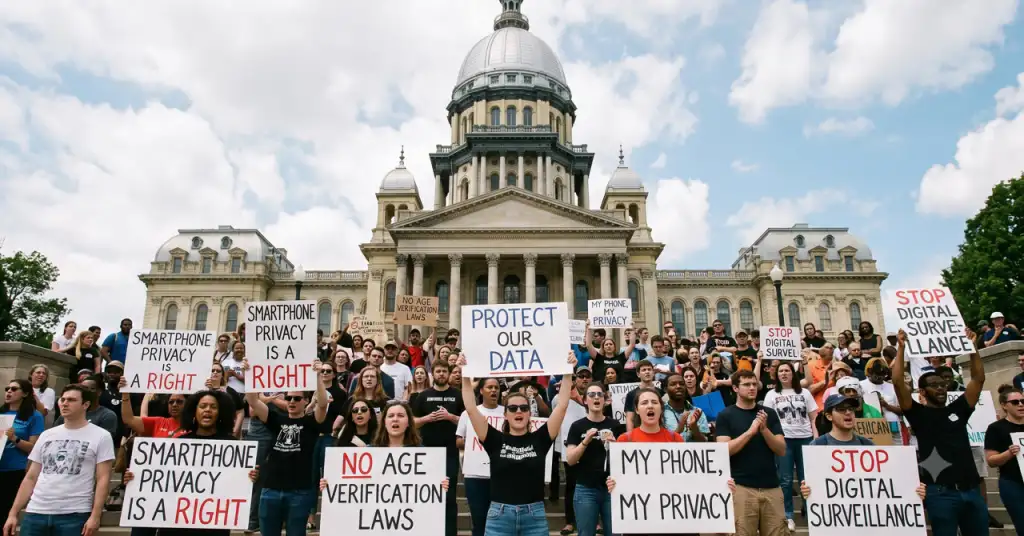
A bill moving through the Illinois legislature would require Apple, Google, and Microsoft to embed age verification directly into the operating system of every smartphone, tablet, and computer sold in the state. HB 5511, passed by the Illinois General Assembly and now awaiting Governor JB Pritzker's signature, is the first law of its kind in the United States - and possibly the world. The Electronic Frontier Foundation has called it an "age surveillance architecture" and is demanding an immediate veto.
What HB 5511 actually requires
The bill requires device manufacturers and operating system vendors to:
- Collect date of birth at setup: When a new device is activated in Illinois, the setup wizard must request the user's date of birth. This applies to iOS, Android, and Windows devices.
- Create a persistent age signal: The OS must store a verified age classification (minor / adult) and make it available to all applications installed on the device through a system API.
- Pass the signal to apps by default: Every app installed on the device receives the age signal automatically. Developers who wish to restrict features for minors use this signal rather than building their own verification.
- Verify with a government-issued document: The bill contemplates verification against government ID, though the implementation details are left to the device manufacturers.
Why the EFF is demanding a veto
The Electronic Frontier Foundation filed a formal opposition letter to Governor Pritzker outlining four specific objections:
- It creates a government-linked ID database: Verification against a government document means a third party - presumably a government database or a licensed verification service - must confirm the document is real. That creates a record linking device identity to real-world identity and age.
- It mandates surveillance of all users, not just minors: To know who is a minor, the system must first identify all adults. Every device user in Illinois becomes a data point in an age-classification system controlled by Apple, Google, and Microsoft.
- It is constitutionally vulnerable: The EFF argues the law violates the First Amendment by imposing prior restraints on information access and the Fourth Amendment by mandating collection of biometric or identity data without a warrant.
- The scope is unlimited: The age signal the OS passes to apps is not limited to social media or adult content platforms. Every app - from banking to weather to news - receives the signal. The bill creates an age classification infrastructure with no defined limit on how it can be used.
The technical mechanics: why VPNs cannot help
Understanding why this bill is technically different from every previous age verification law requires understanding where the verification lives. Current age gates - on adult websites, on social media signup flows, in app stores - live at the network or software layer. A user can bypass them by routing traffic through a VPN, using a browser in a jurisdiction with no age gate, or lying during signup.
HB 5511 places the verification at the OS kernel level. When an app calls the system API to check user age, it receives a response from the operating system itself - not from a network request that can be intercepted or redirected. A VPN encrypts and reroutes network traffic. It has no visibility into kernel-level API calls. The verification happens on the device before any network request is made.
This is analogous to the difference between a website asking your location (which you can spoof with a VPN) and your phone's GPS telling an app your coordinates (which a VPN cannot affect). The privacy threat model for kernel-level age verification is closer to biometric systems than to web-based age gates.
What this means for device manufacturers
Apple and Google face an uncomfortable choice if HB 5511 becomes law: implement a state-specific age verification layer in their operating systems for Illinois users, or exit the Illinois retail market. Neither option is trivial:
- State-specific OS variants create fragmentation in systems designed for global uniformity. Apple in particular has resisted building jurisdiction-specific device software, having withdrawn services from Russia and China at the app level rather than modifying iOS itself.
- Age verification at setup requires a verification infrastructure that doesn't currently exist. Apple's App Store age verification is account-level, not device-level. A government-document check at device setup would require new partnerships with ID verification services and changes to the setup flow globally or regionally.
- Liability for minors who successfully lie during setup falls, under the current bill text, on the platform - not the minor or the app developer. This creates significant compliance risk.
The global context: from websites to devices
Apple has already taken voluntary steps toward account-level age verification in the UK, integrating Apple ID identity features into iOS 26.4. But that is account-level verification - it confirms who holds the Apple ID, not who is holding the phone. HB 5511 targets the device itself.
Russia's age verification scheme requires platforms to check government ID before granting access to social media - but that verification happens at the app or service level, and VPNs remain a practical (if legally risky) circumvention tool in practice. Illinois HB 5511 would be the first attempt to close that technical gap at the device level.
The EU's Chat Control proposal attempts to mandate scanning of encrypted messages - a different technical approach but the same policy impulse: using OS or platform infrastructure to enforce content policy that was previously unenforceable at the network layer. The Illinois bill represents the logical endpoint of this trend applied to age verification.
The UAE's ban on social media for under-15s shows how far governments are willing to go to enforce age restrictions - but the UAE's approach relies on platform compliance and ID checks at signup, tools that technically sophisticated minors can circumvent. Illinois is proposing something the UAE has not: mandatory enforcement at the device kernel level.
What happens if Pritzker signs it
If Governor Pritzker signs HB 5511, Illinois becomes the first jurisdiction in the world to mandate OS-level age verification. Several outcomes follow:
- Immediate legal challenges. The EFF has signaled it will pursue litigation. Apple and Google are likely to join challenges given the compliance burden. Federal courts would likely grant an injunction while the constitutional questions are resolved.
- Template legislation for other states. Texas, Florida, and Utah have all shown appetite for aggressive tech regulation. A signed Illinois bill becomes a legislative template for approximately 15 states that have active digital protection bills in committee.
- Pressure on Apple and Google to offer a voluntary alternative. Both companies would prefer to implement a self-regulated age API rather than comply with state-specific mandates. HB 5511 accelerates whatever negotiations are happening between major platforms and child-safety legislators.