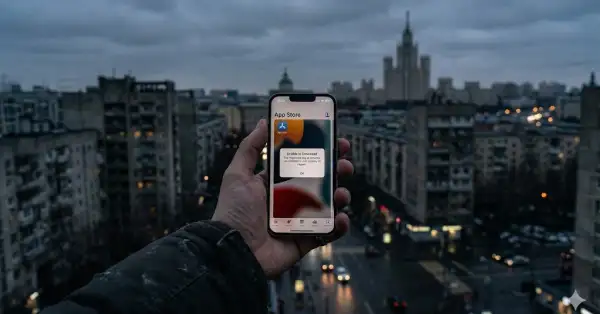
Yandex Pay is out of the App Store: nothing left to reinstall it from

On 12 August 2026 the Yandex Pay app disappeared from the Russian App Store. Copies already sitting on iPhones keep working, but nobody can install it again or update it: on iOS the App Store is the only source of apps, and it is no longer there. Yandex told users their money is untouched and asked them not to delete the app from their phones.
What exactly happened
Yandex Pay is the payment service of Yandex Bank: cards, QR payments, instalments. In July the app had already vanished from App Store catalogues outside Russia, and the Russian one was the last where it remained. Now the page for it returns an error there too.
The company confirmed the removal in its own channel, said the service keeps running and advised iPhone owners to turn off automatic updates and to keep the installed app in place. The web version works in Safari, and on Android the app is still in Google Play and RuStore.
Why Apple did it
Apple has not explained this particular removal. It did explain the previous one: when the state messenger MAX left the store in June, the company said it follows the laws of the countries it operates in and removed the app under sanctions compliance rules, without naming the sanctions.
For Yandex Pay the likely reason is on the record. On 16 June the United Kingdom sanctioned Yandex Bank along with the banking arm of Wildberries and the insurer Rosgosstrakh: an asset freeze plus a ban on correspondent relationships and on processing payments. A store that distributes the app of a sanctioned bank, and takes payments for it, has a compliance problem in London.
- Apple removes the messenger MAX, citing sanctions compliance. A day later push notifications stop arriving on iPhones.
- The United Kingdom sanctions Yandex Bank, the bank of Wildberries and the insurer Rosgosstrakh.
- All VK apps disappear from the App Store worldwide.
- Yandex Pay leaves App Store catalogues outside Russia.
- Russia's antimonopoly service opens a case against Apple over the missing preinstallation of RuStore and MAX. The possible fine is up to four billion roubles.
- Yandex Pay leaves the Russian catalogue as well.
What an iPhone owner actually loses
The immediate loss is small and the delayed one is not. The app on the phone works until something breaks: a new phone, a reset, a system update that takes the old build with it. After that there is no way back, because there is no second store to fall back on.
Updates stop too, which matters most for a payment app: a bug in it will not be fixed on your device. And the MAX case showed that removal can reach further than the download button. When an app leaves the store, Apple can revoke the credentials it uses for push, and messages start arriving only when the user opens the app by hand.
When there is no store of your own
This is where the structural part starts, and it has little to do with any single company. Two American firms decide what can be installed on almost every phone on the planet. On Android that power is soft: there are alternative stores and there is the plain APK file, which is why Yandex Pay survives there. On iOS the power is absolute, and a country that has neither its own mobile system nor its own store has nothing to answer with. Russia has RuStore, and it is useless on iPhone, because Apple does not allow it.
Hence the mirrored pressure: Apple removes apps to satisfy sanctions law, the Russian regulator opens a case because those same apps are not preinstalled, and the user sits between the two with a phone that quietly loses functions.
Not a Russian story
The same mechanism has been used everywhere. In 2017 Apple pulled hundreds of VPN apps from the Chinese App Store after a demand from Beijing. In April 2024 WhatsApp and Threads went the same way in China, again on the authorities' orders. In 2026 India demanded that GitHub take down the offline messenger Bitchat and gave the platform three hours to comply.
The counter-example is the European Union, where the Digital Markets Act forced Apple to allow alternative marketplaces and app installs from outside its store. That is not a favour to a particular app, it is the same idea from the other side: distribution should not have a single owner.
A VPN does not bring the app back
It is worth stating plainly, because the reflex is to reach for one. A VPN changes the route of your traffic, not the country of your Apple account. Which catalogue you see is decided by the account and the payment method attached to it, so the app stays missing however clever the tunnel is. A VPN helps when a service is blocked on the network, and this is a different kind of removal.
What to do now
- Do not delete the app if you use it: on iOS this is a one way door.
- Turn off automatic updates for it, so the system does not replace a working build with nothing.
- Add the web version to the home screen. It opens like an app and does not depend on the store.
- Keep a second way to pay. The rule of thumb after this year: any service tied to one store needs a backup that is not.
• «Яндекс пэй» удалили из App Store - Ведомости
• «Яндекс Пэй» удалили из App Store: пользователям iPhone советуют не удалять приложение - iXBT
• Apple удалила MAX из App Store из-за санкций - Habr
• UK imposes sanctions against Rosgosstrakh, subsidiary banks of Yandex, Wildberries - Interfax
• ФАС возбудила дело против Apple - Ведомости