US Supreme Court: Location History Requires a Warrant - Chatrie Ruling Explained
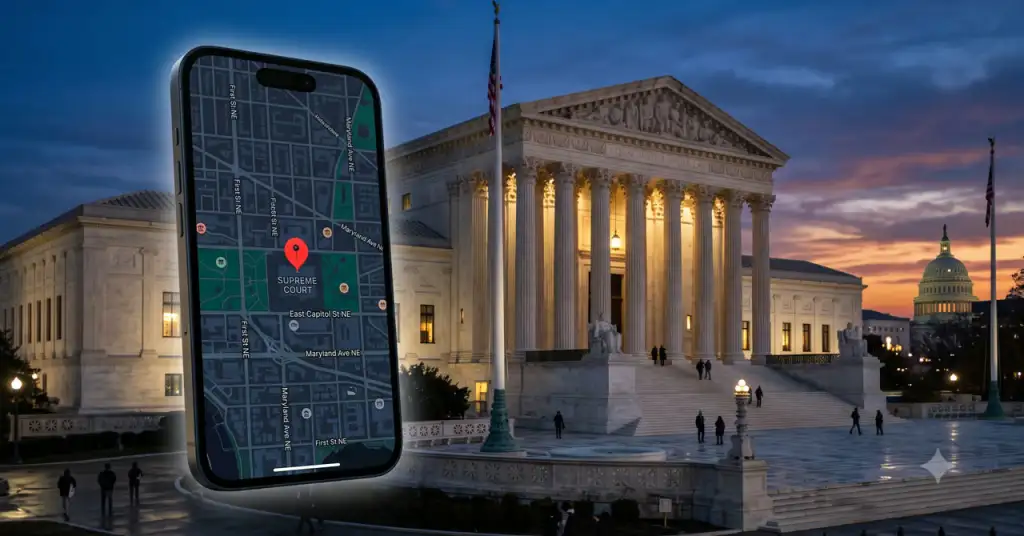
The US Supreme Court delivered a landmark ruling on June 29, 2026, in Chatrie v. United States: police must obtain a warrant before demanding location history data from technology companies. The 6-3 decision extends Fourth Amendment protections to geolocation records and directly ends the practice of geofence warrants - where law enforcement could demand that companies like Google, Apple, or Uber hand over data on everyone whose phone was in a specific area at a specific time, without any prior judicial approval.
What geofence requests are
A geofence warrant is a request sent to a technology company asking for the identifiers of every device present within a geographic boundary at a particular time. A bank robbery occurs at 2pm on Main Street; police send Google a request for all Android devices within a 500-meter radius between 1:45pm and 2:15pm. Google returns the list. Police narrow it down, then request detailed movement history for specific devices.
No individual is named in the initial request. No suspicion is required. The warrant goes to Google, Apple, or Uber, not to any specific person. The request creates a digital lineup of everyone who happened to be in the area - innocent bystanders included.
Until June 29, 2026, this practice was legally permissible under the third-party doctrine - the legal principle that information voluntarily shared with a third party carries no reasonable expectation of privacy.
The third-party doctrine and its limits
The third-party doctrine originates in two Supreme Court decisions: Katz v. United States (1967) and Smith v. Maryland (1979). The logic was straightforward for its era: if you give information to someone else, you accept the risk they might share it. Bank records, phone company logs - these were considered voluntarily disclosed and therefore unprotected by the Fourth Amendment.
Location data from modern smartphones fits uneasily into this framework. Your phone passively broadcasts its position to cell towers, Wi-Fi networks, and GPS satellites. You do not choose to share location data - it is a byproduct of owning a connected device. The doctrine was designed for records a person deliberately creates and shares, not for the continuous automated surveillance trail that a smartphone generates 24 hours a day.
How Chatrie builds on Carpenter
Carpenter v. United States (2018) was the first major crack in the third-party doctrine. The Court held that cell-site location information - records kept by carriers showing which towers a phone connected to - required a warrant despite being held by a third party. The reasoning: comprehensive location records created without active consent exceed what the third-party doctrine was designed to permit.
Chatrie v. United States takes the next logical step. The case arose from a bank robbery in Virginia. FBI agents obtained a geofence warrant from Google, which returned location data on 19 devices near the scene. One belonged to Okello Chatrie, who was subsequently charged. His defense challenged the constitutionality of the geofence process from the beginning.
The Court's majority opinion holds that location history is functionally equivalent to a personal diary - a comprehensive record revealing the most intimate details of daily life. A person who uses a navigation app does not consent to government surveillance of their movements any more than they consent to a wiretap by making a phone call.
What the ruling changes in practice
The immediate effect is that geofence requests to Google, Apple, and Uber now require traditional probable-cause warrants naming a specific suspect or location - not reverse-location orders that begin with a geographic area and work backward to identify individuals. FISA Section 702 already operates in a legal gray zone following its expiration in June 2026. The Chatrie ruling adds another constraint on warrantless government data collection.
The ruling also has implications beyond geofence requests. Law enforcement agencies had increasingly turned to commercial data brokers that aggregate location data purchased from mobile apps as an alternative route. Motorola Solutions faced a class-action lawsuit for sharing license plate location data with ICE without warrants. Whether purchasing commercial location records now requires a warrant after Chatrie is a question that will reach the courts.
What this means for privacy tools
A VPN encrypts the traffic between your device and a VPN server. It does not prevent your phone from connecting to cell towers, recording GPS coordinates, or sharing location with apps. The data that geofence requests target - location records stored by Google, Apple, Uber, and similar companies - is generated regardless of whether you use a VPN.
The Chatrie ruling provides a legal protection that operates at a different layer: it requires the government to show probable cause to a judge before accessing that data. A VPN and a constitutional warrant requirement are complementary protections. One limits what can be intercepted in transit; the other limits what the government can compel companies to disclose. For users outside the United States, the practical question is which companies hold your location data and under which legal system they operate.
• Chatrie v. United States: SCOTUS Rules Location History Needs a Warrant - The Record
• Supreme Court limits geofence warrants in landmark Chatrie ruling - CyberScoop
• EFF: SCOTUS Chatrie Decision Ends Warrantless Geofence Requests
• Chatrie v. United States - Supreme Court of the United States