Telegram Blocking in Russia 2026: How Throttling Creates "Two Russias" and What "MAX" Messenger Has to Do With It
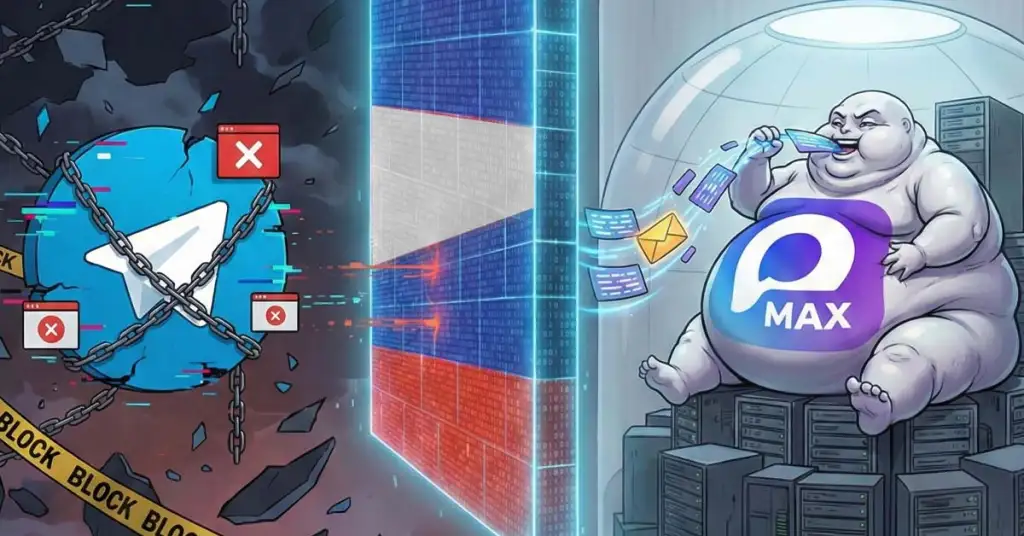
By early 2026, what many feared has become a reality. Telegram in Russia has ceased to be just a convenient messenger — it has turned into a battlefield for information. Against the backdrop of traffic throttling and official statements from Roskomnadzor, users are aggressively pushed to switch to the domestic alternative — the «MAX» messenger.
But this is not just about changing an icon on a smartphone screen. We are witnessing the formation of a fundamental information split in society. Those who use VPNs and those who remained in the «Cheburnet» are beginning to live in different realities.
Telegram as Critical Infrastructure
In 2025, Telegram's monthly audience in Russia reached a historic peak — 105 million unique users. It is no longer a niche app for geeks, but a digital habitat for 62% of the population who visit it daily, spending an average of 50 minutes there.
Loss of stable access to Telegram is a blow to four key areas of the country's life:
- Military: De facto the main communication channel at the tactical level.
- Business: After the departure of Western platforms, 95% of Russian companies buy advertising here.
- Media: 85% of users get their news specifically from Telegram channels.
- Volunteering: Coordination of humanitarian aid relies on chats and bots.
Operation «Displacement»: Telegram vs MAX
Against the backdrop of access problems with Telegram, shares of VK (owner of the MAX messenger) soared by 4.57% in just one trading session. The market reacts instantly: investors understand that administrative resources have been thrown into reshaping the market.
However, for the ordinary user and small business, this transition means a loss of freedom and money. Let's compare the two realities forming right now.
| Characteristic | Russia with VPN (Telegram) | Russia without VPN (MAX Messenger) |
|---|---|---|
| Information Agenda | Global news, diverse viewpoints, discussions | Unified federal agenda, censorship, entertainment content |
| Business and Advertising | Access to solvent audience, cheap leads | High competition, expensive advertising, over-regulation |
| Privacy | End-to-end encryption, source anonymity | Full intelligence service access, no secrecy of correspondence |
| Access to Services | YouTube, Instagram, Netflix, Steam | VK Video, RuTube, limited game selection |
Strategic Trap: Surrendering the «Information Front»
Blocking Telegram creates a dangerous paradox that many experts are warning about. by technically limiting access, the state is voluntarily abandoning the main information battlefield of modern times with its own hands.
The logic is simple: if pro-government channels and official media move to the closed «MAX» loop, while opposition and foreign sources remain in Telegram, an echo chamber effect will arise:
- Millions of active citizens using VPNs will remain in Telegram.
- They will find themselves in a space completely cleansed of the official Russian point of view.
- Instead of «protecting citizens», blocking will lead to this audience consuming content exclusively from geopolitical adversaries.
The Economics of Blocking: Why Business Loses Money
For 57% of advertisers on Telegram, who represent small businesses, blocking means disaster. Alternatives are either too expensive or ineffective. Without a VPN, entrepreneurs lose access to the tools that feed their families.
| Traffic Channel | Cost Per Click (CPC) | Sales Conversion | Cost Increase |
|---|---|---|---|
| Telegram (via VPN) | 35 RUB | 4.5% | 0% (Base) |
| MAX Messenger | 85 RUB | 1.2% | +350% |
| VKontakte | 120 RUB | 2.1% | +240% |
| Yandex.Direct | 250 RUB | 3.5% | +180% |
The Information Split: Two Russias
We are returning to the concept of a divided society. Polarization is an evil that leads to fragmentation, not order. People stop understanding each other because they consume content from diametrically opposed sources.
Russia without VPN plunges into an information vacuum dominated by entertainment content and the point of view approved «from above». Russia with VPN maintains a connection with the global world, access to independent analytics, and the ability to conduct business without borders.