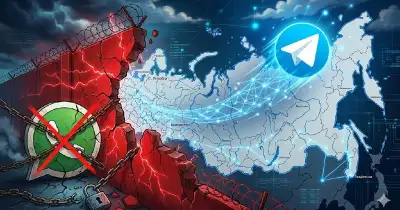
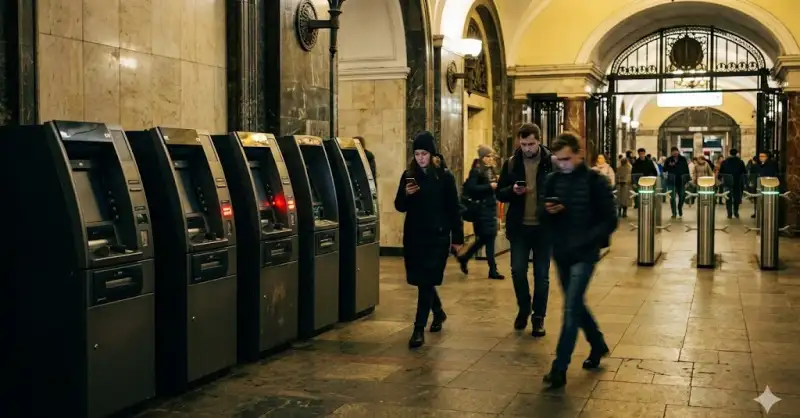
On April 3, 2026, Russia's months-long campaign to throttle VPN traffic produced a spectacular and unintended consequence: a nationwide outage of the country's largest banks. Customers of Sberbank, VTB, T-Bank and Ozon Bank could not pay, transfer money, or log into mobile apps for most of the day. The Moscow metro opened turnstiles for free because payment terminals failed. Retailers in several regions put up "cash only" signs. Pavel Durov, from Dubai, took to his Telegram channel to connect the dots: "Their blocking attempts just triggered a massive banking failure," he wrote, framing the incident as "Digital Resistance" - tens of millions of Russians mobilizing to route around the state's dragnet. Two weeks later, on April 15, the same campaign moved to its next phase: a Ministry of Digital Development ultimatum forcing major platforms to block VPN users or lose IT accreditation. The backfire from April 3 is now a warning about how the rest of April is likely to go.
What Broke and Why
The technical mechanism was blunt. Russia's authorities maintain large blacklists of IP address ranges belonging to VPN and proxy providers. Filtering infrastructure, the TSPU boxes (Technical Means of Countering Threats) installed at every major Russian ISP, drops packets to and from those ranges. The problem is that the lists are sloppy. Cloud-service IP allocations change constantly, and legitimate financial services routinely share address space (AWS regions, Cloudflare ranges, Google Cloud blocks) with precisely the kind of VPN providers the government is trying to kill.
On April 3, the blacklist caught up with a batch of IP ranges tied directly to Sberbank, VTB, T-Bank and Ozon Bank payment infrastructure. The filter did exactly what it was told to do: it stopped traffic to those addresses. The banks' mobile apps, online banking portals, and card-processing terminals all went dark. Sberbank put out a terse statement about a "technical issue." Several Russian outlets removed stories that had publicly linked the outage to VPN blocking, a telling detail of its own.
The Human Impact
For most of a workday, paying for anything digital in Russia became difficult or impossible. Shoppers in Moscow, St. Petersburg and smaller cities reported that payment terminals in supermarkets, cafes and transit stations simply did not respond. The Moscow metro, rather than allow thousands of commuters to pile up, opened turnstiles and let passengers through without payment. A regional zoo asked visitors to bring cash. Food delivery was disrupted because in-app wallet top-ups failed. The scale made the usual government line ("the authorities are not blocking anything, this is a private technical issue") impossible to maintain in its usual form.
Durov's 'Digital Resistance'
Pavel Durov, currently in Dubai while facing his own French criminal investigation, used his Telegram channel to reframe the incident. "Their blocking attempts just triggered a massive banking failure," he wrote on April 4. He went further: "Tens of millions of Russians are mobilizing to circumvent these restrictions. This is Digital Resistance." The phrasing was pointed. Russia has traditionally treated VPN use as a niche activity of activists, IT professionals and journalists; the April 3 outage forced ordinary bank customers, metro riders and retailers to understand, in real time, that VPN filtering is not a clean surgical operation with predictable costs. It is a crude, infrastructure-wide measure whose fallout everyone shares.
From April 3 to April 15: the campaign escalates
The April 3 outage did not slow the campaign. It accelerated it. On April 15, the Ministry of Digital Development ordered the country's largest online platforms (Yandex, VK, Ozon, Wildberries, Lamoda, Avito, X5 retail, Kinopoisk, Sberbank, HeadHunter, CIAN) to detect and block VPN users directly at the application layer, on pain of losing their IT accreditation and tax benefits. Mobile carriers were instructed, the same day, to warn customers that their apps might fail unless VPNs were disabled. The technical detection now includes geolocation-desynchronization checks: if the IP points to the Netherlands while the SIM registers Russian tower IDs, the app concludes that a VPN is in use and denies service. We covered the April 15 platform blockade in detail in our earlier reporting (linked below).
Why This Is Hard to Fix
Detecting VPN traffic accurately is a genuinely difficult engineering problem. Modern VPNs use obfuscation (Fake TLS, WireGuard-over-HTTPS, Cloak, pluggable transports) that makes their packets indistinguishable on the wire from ordinary TLS web traffic. To filter them, Russia's TSPU devices depend on IP-range blacklists, protocol signatures, and side-channel heuristics (timing, packet sizes, SNI fields). All three approaches produce false positives. IP-range blocks also hit banks, as April 3 showed. Protocol-signature filtering breaks legitimate apps that happen to use similar handshake patterns. Heuristic blocking destroys video conferencing and game traffic. There is no filter that catches VPNs and nothing else; the Russian government has spent several billion rubles trying to build one and keeps shipping broken production builds.
What This Means for VPN Users
Two practical takeaways. First, the state's technical tolerance for false positives is high when it suits them; Sberbank going dark for a day is, evidently, an acceptable cost of the policy. Expect more such outages. Second, the harder the state pushes on filtering, the more that ordinary users, not just privacy enthusiasts, develop working knowledge of VPN technology, obfuscated protocols and alternative circumvention. Durov's "Digital Resistance" framing is not purely rhetorical. Russian engineering talent understands this stack better than most of the world, and a lot of that talent now has reason to keep it working.
For a VPN user on Russian networks, the practical survival rules have gotten specific: choose providers that publish obfuscation options (Fake TLS, Shadowsocks with AEAD, WireGuard over TCP/HTTPS); avoid providers whose IP ranges appear on every public blocklist; keep two different VPN services configured for failover; and, critically, disable the VPN when logging into Russian banking apps, payment systems and state services. Using the VPN in parallel with local apps now risks app-side account flags and, as April 3 showed, may not even be possible to keep working while the banking infrastructure is collateral.
What Comes Next
Expect further outages as Russia expands its IP-range blacklist. Expect more platforms to join the VPN-detection whitelist under Ministry pressure. Expect Telegram and other messaging services to roll new obfuscation updates in response; Durov has already shipped one since the April crackdown. And expect the pattern to repeat elsewhere: other states that are watching Russia will copy the parts of the policy that work and will skip the parts, like torching their own banking system, that are too politically expensive at home. For vpnlab.io readers outside Russia, today's story is mostly a preview of the new normal.
Related Coverage on vpnlab.io
Three prior pieces build the picture of Russia's 2026 internet crackdown:
- Digital Blockade 2026: Why VPNs and Telegram Stopped Working in the Russian Federation - our detailed coverage of the April 15 platform-level blockade and the Ministry of Digital Development ultimatum.
- Durov Upgrades Telegram Protocol to Beat Russia Blocks and Blasts WhatsApp Encryption - how the April protocol update fights DPI detection on Russian networks.
- Russian Telecoms Freeze Internet Channel Expansion to Europe: The End of Fast VPNs? - the capacity side: why Russia is also throttling bandwidth to Europe, independent of VPN filtering.
Conclusion
See Also
• Russia's VPN Crackdown Caused Bank Outage, Telegram Founder Says - Bloomberg
• Whoops: Russia's Attempt To Block VPNs Causes Major Banking Failure - Techdirt
• Russia's VPN crackdown triggers payment system disruption - Cybernews
• Russian Websites Begin Blocking VPN Users as Internet Controls Tighten - Moscow Times
• Russia's major mobile carriers warn users to disable VPN for apps to work - Meduza
• Russia orders major websites to block VPN traffic from April 15 - bne IntelliNews