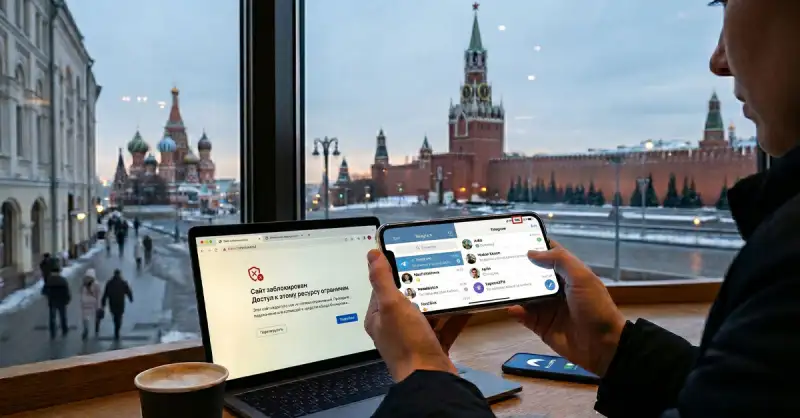
In mid-April 2026, the architecture of the Russian internet underwent fundamental changes. Despite the authorities' statements that a complete ban on VPNs is not being considered, the state has moved to proactively block workarounds. The main blow fell on users of the Telegram messenger and clients of major digital platforms.
What does this mean for the average user? Formally, ordinary citizens are not fined for VPNs, but using the free internet is becoming critically difficult and expensive. Let's break down the main events of April 2026: from corporate censorship to the collapse of Telegram.
Business as a Roskomnadzor agent: Ministry of Digital Development ultimatum
From April 15, 2026, the Ministry of Digital Development obliged the largest IT companies (marketplaces, banks, online cinemas) to independently restrict access to their services for users with an active VPN. Otherwise, businesses face the loss of IT accreditation, loss of tax benefits, and exclusion from government «white lists».
- App-side blocks: When trying to log into Wildberries, Ozon, Kinopoisk, Sberbank, or Yandex Pay with a VPN enabled, the services issue a connection error or directly demand to disable the bypass tools.
- New detection technologies: Mobile applications now analyze geolocation data desynchronization. If your IP address points to the Netherlands, but your SIM card (operator codes) and GPS point to Russia, the system concludes that a VPN is being used and restricts access.
- Economic barriers: Mobile operators have been instructed to introduce a fee for international internet traffic exceeding a strict limit of 15 GB per month. Since all VPN traffic goes through foreign servers, it automatically falls under this limit.
Telegram crisis: from throttling to 99% failures
The Telegram messenger has been subjected to an unprecedented technical attack. Between April 10 and 13, 2026, the level of failed requests to the service's servers reached a critical mark of 99-100%, making the application practically inaccessible even when using many proxies and VPNs. This became possible thanks to the expansion of the capacities of TSPU (technical means of countering threats), which are now able to recognize and destroy MTProto protocol packets by signatures.
| Period | Telegram Restrictions | Blocking Methods |
|---|---|---|
| August 2025 | Blocking of audio and video calls | Hardware restrictions by Roskomnadzor to protect against scammers |
| February 2026 | Official start of "throttling" | Artificial restriction on the transfer of heavy media files (photo/video) |
| April 10-15, 2026 | Up to 100% denial of service | Deep Packet Inspection (DPI) and filtering of obfuscation protocols |
What this means for ordinary users
Publicly, government representatives continue to assert that there are no penalties for individuals using VPNs — this was directly stated by presidential press secretary Dmitry Peskov. However, the technical reality says otherwise: the state is consistently creating conditions under which the operation of independent circumvention tools becomes unstable and expensive.
A full 100% block of Telegram for technically literate users is almost impossible without completely disconnecting the Runet from the global network, but for most people, access to the messenger has become more complicated. The Telegram team has already released protocol updates to bypass the new restrictions.
• Russian services began massively blocking users with VPNs (HashTelegraph)
• Access to sites via VPN will be banned in Russia from April 15, 2026 (Gogov)
• Failing at 99%: what is happening with Telegram in Russia (Men Today)
• How apps determine that you have a VPN enabled (Habr)
• Why it is technically impossible to completely block Telegram (Habr)