Durov on EU-UK Censorship Playbook: 'Protect the Children' as Cover
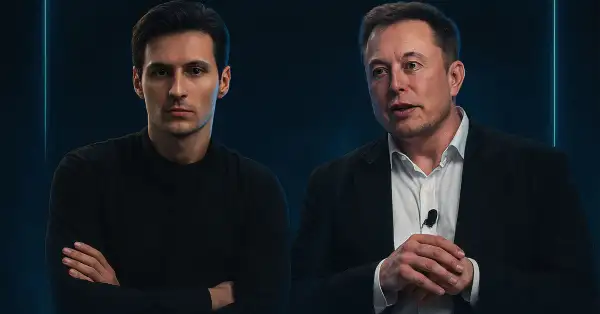
On April 20, 2026, Telegram founder Pavel Durov summarized in a single paragraph what he calls the EU and UK playbook for regulating social media: offer CEOs secret deals to censor dissent, open criminal cases when they refuse, and wrap the whole campaign in the phrase "protecting the children." The post (durov/496) landed at 16:25 Riga time and went viral within hours, as it coincided with two other stories that fit the exact pattern Durov described: Elon Musk being summoned by the Paris prosecutor over alleged content on X, and the UK Ofcom deadline of April 16 for platforms to perform children's access assessments under the Online Safety Act.
The three-step pattern Durov describes
Durov's claim is not new, but his April 20 post compresses it into a form that is easy to quote and impossible to soften. Step one: regulators quietly ask platform CEOs to remove specific content or categories, usually political or dissident. Step two: if the CEO refuses, criminal proceedings follow, often on charges unrelated to the original ask (drug content, CSAM, terrorism). Step three: when journalists or civil society question why so many criminal cases target platform owners at once, the official answer is "this is about protecting the children." Durov says this phrase has become the default legal and public-relations cover for a much broader censorship agenda.
The Durov case as evidence
The most concrete evidence for step two is Durov's own situation. He was arrested in France in August 2024 and has been under formal investigation ever since, facing charges that could carry up to ten years of prison each. In April 2026 he publicly said that more than a dozen separate criminal counts have accumulated, and that the Paris prosecutor is "politically controlled" by the government. On the same week Durov wrote post 496, French prosecutors formally summoned Elon Musk over alleged content on X. Two platform owners, two criminal referrals, one week. The pattern Durov describes is no longer a conspiracy theory to his audience.
The "protecting children" cover in 2026
The phrase is not hypothetical in 2026. In the same month Durov published his post, three concrete pieces of legislation used child safety as the lead justification:
- UK Online Safety Act: Ofcom's children's access assessment deadline fell on April 16, 2026, forcing every platform with UK users to implement age verification that effectively ends anonymous accounts. A petition to repeal the law has crossed 500,000 signatures.
- EU Age Verification App: launched by the European Commission on April 15-17 under the Digital Services Act, marketed as "zero-knowledge." Security researchers broke it in under two minutes. Durov called it "a surveillance tool, hackable by design."
- CSAR 2.0 (Chat Control): the trilogue over client-side scanning of encrypted messages resumes on May 4, 2026. It is framed as a tool to find CSAM but would effectively install a backdoor inside every E2E messenger.
Each of these measures is defensible on its own. What Durov is pointing to is the aggregate: when the child-safety justification is used to simultaneously (a) end anonymity, (b) deploy age-verification infrastructure, and (c) break end-to-end encryption, the policy result is indistinguishable from a general surveillance framework.
Why this matters for users, not just platforms
If the pattern holds, two things follow for ordinary users in the EU and UK. First, anonymous accounts on major platforms are becoming impossible: by the end of 2026, most will require a government-backed age credential. Second, encrypted messaging may lose its encryption guarantee at the endpoint, where CSAR 2.0 scanning would happen before the message is sealed. In that world, the only layer still under the user's control is the network itself: who sees what you connect to and from where.
Where VPNs fit into this
A VPN does not stop a government from compelling a platform to deploy client-side scanning. What a VPN does is break the trivial link between your internet-level identity (IP, ISP, DNS queries) and your platform-level identity (account, session, phone number). In a regime where age-verification, platform KYC, and potential CSAR scanning are being stacked, separating those two identities becomes the last practical layer of user-side privacy. Combined with encrypted DNS, alias email, and unique passwords, a no-logs VPN is the simplest user-installable defense against the aggregation that Durov is warning about.
What happens next
Expect the Durov case in France to move slowly but publicly through 2026. Expect Musk to fight the Paris summons aggressively, which will amplify the "criminal cases against CEOs who refuse" framing. Expect the CSAR 2.0 trilogue on May 4 to be the most contested EU tech vote of the year. And expect the phrase "to protect the children" to appear in every official communication about each of these moves.
Related Coverage on vpnlab.io
- Russia VPN block crashed Sberbank: Durov's Digital Resistance - how state-level VPN blocks cascade into banking failures.
- EU Age Verification App Hacked in 2 Minutes - the "zero-knowledge" app Durov called surveillance-by-design.
- Durov Upgrades Telegram Protocol to Beat Russia Blocks - the technical counter-move to DPI-based VPN filtering.
- Pavel Durov Warns: Spain's New Laws Are a Step Toward Digital Dictatorship - the Spanish precedent Durov opposed in February.
- Musk and Durov vs EU: Censorship, Chat Control, and VPN Benefits - earlier coverage of the same coalition.
Conclusion
See Also
Related: the EU has charged TikTok under the DSA over minors' accounts.
• Pavel Durov post 496 - Telegram
• Spain's Prime Minister hits back at Durov - Euronews
• Durov warns EU Age App can be breached in minutes - Finance Magnates
• Arrest and indictment of Pavel Durov - Wikipedia
• Durov slams Soros-backed EU censorship - RT
• Durov accuses EU of globalist censorship push - Weekly Blitz