CISA Adds Critical Lantronix EDS5000 Vulnerability to KEV Catalog
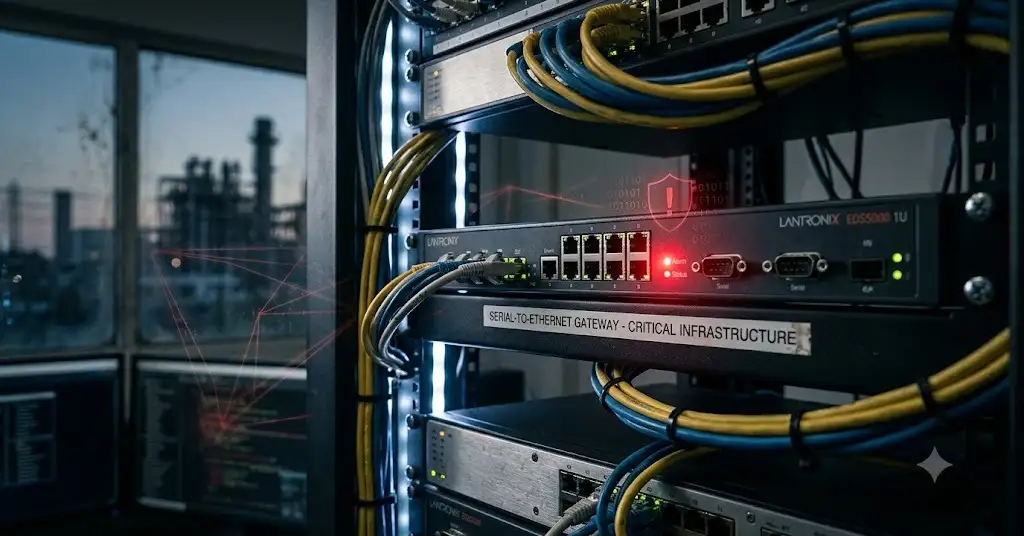
The US Cybersecurity and Infrastructure Security Agency (CISA) added a critical vulnerability in the Lantronix EDS5000 industrial device server to its Known Exploited Vulnerabilities (KEV) catalog in June 2026, alongside a coordinated disclosure advisory warning that the flaw allows unauthenticated remote attackers to gain full administrative control over affected devices. The Lantronix EDS5000 is an industrial serial-to-network gateway widely deployed in critical infrastructure sectors including energy utilities, water treatment facilities, and manufacturing operations. The VPN and network security implications of this vulnerability extend beyond the device itself to the broader question of how unmanaged industrial network gateways become invisible entry points into otherwise secured enterprise networks.
What Is the Lantronix EDS5000 and Why Does It Matter
The Lantronix EDS5000 is a device server - a type of industrial gateway that converts serial communication protocols used by legacy industrial equipment into TCP/IP network traffic. These devices sit at the intersection of older operational technology (OT) hardware and modern enterprise networks, performing serial-to-Ethernet conversion that allows decades-old industrial equipment to communicate with contemporary IT infrastructure without hardware replacement.
This architectural role makes EDS5000-class devices both operationally critical and security-sensitive. They typically have network access to both the industrial equipment they serve and the enterprise network segment through which that equipment is managed. In many deployments, these device servers are accessible from remote management connections, including VPN tunnels used by operational technology teams to monitor and control industrial systems from remote locations.
Lantronix products are deployed across multiple critical infrastructure sectors. The EDS5000 series in particular is used in power generation and distribution facilities, water and wastewater treatment plants, industrial manufacturing environments, and building automation systems. A device with administrative access in any of these environments represents high-consequence potential for an attacker capable of exploiting the vulnerability.
The Vulnerability: Technical Details
The CISA advisory describes the vulnerability as an authentication bypass in the EDS5000's web management interface. An unauthenticated attacker with network access to the affected device can send a specially crafted HTTP request that bypasses the device's login mechanism and achieves full administrative access. This class of vulnerability - authentication bypass to remote code execution or configuration manipulation - is consistently among the most severe categories in industrial control system security because it requires no prior knowledge of device credentials and no user interaction to exploit.
With administrative access to an EDS5000, an attacker can:
- Modify the device's network routing configuration
- Change serial port parameters affecting connected industrial equipment
- Extract configuration data including full network topology information
- Inject commands into the serial communication stream reaching connected industrial systems
- Use the compromised device as a pivot point for lateral movement into adjacent network segments
CISA's inclusion in the KEV catalog indicates that the agency has evidence of active exploitation in the wild, not simply that exploitation is theoretically possible. The KEV catalog is reserved for vulnerabilities with confirmed active exploitation, making CISA's designation a significantly stronger signal than a standard Common Vulnerabilities and Exposures (CVE) publication without KEV listing.
VPN Access and the Remote Management Problem
The Lantronix EDS5000 vulnerability is particularly significant in the context of industrial VPN access. Operational technology teams at utilities and manufacturing facilities routinely use VPN connections to access device servers like the EDS5000 for remote monitoring and configuration. This is operationally rational - sending field technicians to physical locations for routine monitoring is expensive and slow compared to remote access.
However, VPN access to OT networks frequently creates a security architecture where the VPN tunnel successfully authenticates the user at the network perimeter, but the devices accessible through that tunnel operate under much weaker authentication assumptions. A legitimate VPN user connecting to an industrial network can access an EDS5000 through its web interface. An attacker who compromises VPN credentials - through phishing, credential stuffing from a breach at an unrelated organization, or any other credential access technique - can use those credentials to establish a VPN tunnel and then exploit the EDS5000 authentication bypass to achieve full device control without needing any device-specific credentials.
This two-step attack pattern - VPN credential compromise followed by exploitation of a weak OT device - is a documented attack pathway in multiple industrial infrastructure incidents. The Lantronix advisory underscores why network segmentation between VPN-accessible management networks and industrial device networks is a security control, not an administrative convenience.
Exposure Assessment: How Many Devices Are at Risk
Industrial Shodan and Censys searches for Lantronix EDS5000 web interfaces exposed to the public internet consistently reveal thousands of devices with externally accessible management interfaces, primarily concentrated in North America, Europe, and industrial regions of Asia. The devices accessible from the internet represent the most acutely at-risk population, but the larger exposure is within enterprise networks where these devices are accessible from network segments that can be reached by compromised VPN sessions, lateral movement from other compromised devices, or direct access by malicious insiders.
Critical infrastructure operators are explicitly targeted by several threat actor categories that have demonstrated both the technical capability and intent to target industrial systems. CISA's KEV listing in the context of a device deployed in energy, water, and manufacturing facilities represents exactly the type of scenario where exploitation by nation-state or sophisticated criminal actors is a realistic threat rather than a theoretical possibility.
Remediation and Mitigation
Lantronix has released updated firmware for the EDS5000 series that addresses the authentication bypass vulnerability. Organizations operating affected devices should prioritize firmware updates on a timeline consistent with the KEV catalog remediation guidance - which sets binding deadlines for federal agencies and serves as a strong recommendation for critical infrastructure operators in all sectors.
For organizations that cannot immediately apply the firmware update, CISA recommends:
- Isolate affected EDS5000 devices from direct internet exposure and from networks accessible via general VPN tunnels
- Restrict device management traffic to dedicated out-of-band management networks with separate authentication and access logging
- Conduct remote access to industrial device servers through purpose-built industrial remote access solutions rather than general-purpose enterprise VPN infrastructure
- Implement network monitoring for unusual HTTP traffic patterns targeting EDS5000 web interfaces
Network monitoring for unusual HTTP traffic to EDS5000 web interfaces, particularly crafted requests that deviate from normal management patterns, should be implemented as an interim detection measure. Industrial protocol monitoring on the serial-side of affected devices can provide additional indication of whether an attacker has manipulated communication between the device server and connected industrial equipment.
The Broader Pattern: Legacy OT Devices as Persistent Vulnerabilities
The Lantronix EDS5000 advisory follows a consistent pattern in industrial cybersecurity advisories: a widely deployed legacy device performing a critical bridging function between old OT equipment and modern networks contains an authentication vulnerability that has been present for years or longer, difficult to patch due to operational constraints, and now confirmed to be under active exploitation.
This pattern will continue as long as critical infrastructure operators face the operational reality of maintaining decades-old industrial equipment that cannot be replaced on the same timeline as enterprise IT. The security response cannot rely solely on patching - it must include network architecture controls that limit the blast radius when individual device vulnerabilities are exploited, detection capabilities that identify exploitation attempts, and incident response procedures specific to OT environments where recovery from a compromised industrial device requires different procedures than recovery from a compromised IT endpoint.