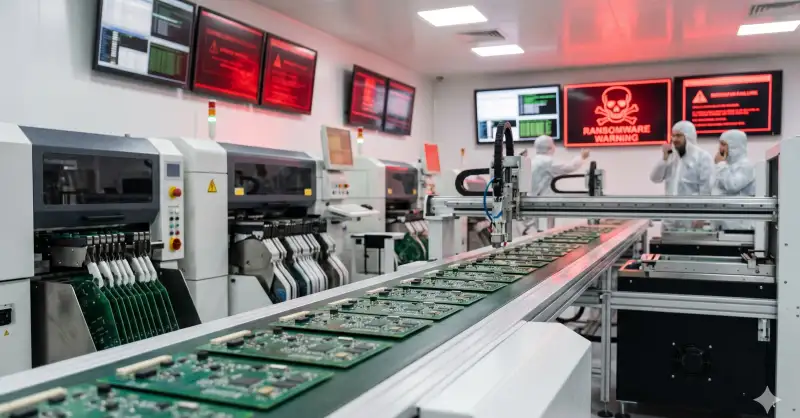
A ransomware group known as Nitrogen has claimed responsibility for a major cyberattack on Foxconn, the world's largest contract electronics manufacturer, breaching facilities in Wisconsin and Texas and allegedly exfiltrating 8 terabytes of confidential design documentation. The stolen files reportedly include proprietary schematics and project data for products built on behalf of Apple, Nvidia, Dell, and Google. Foxconn confirmed the incident on May 13, 2026, describing it as an attack on two of its North American manufacturing plants.
What Happened: Nitrogen Ransomware Targets Foxconn North America
The Nitrogen ransomware group - also tracked under the name "Nitrogen" by threat intelligence firms - posted claims on its dark web leak site asserting that it had successfully penetrated Foxconn's networks at its Racine, Wisconsin and Fort Worth, Texas facilities. The attackers claim to have spent weeks inside the network before deploying ransomware, during which time they exfiltrated approximately 8TB of data.
According to documents the group has begun publishing as proof, the stolen data includes confidential engineering schematics, manufacturing specifications, component sourcing data, and internal project communications related to products being developed or manufactured for some of the biggest names in consumer and enterprise technology. Foxconn's statement confirmed the attack but did not address the specific scope of the data theft, saying only that it was "investigating the extent of the incident" with assistance from cybersecurity firms and law enforcement.
- Attacker: Nitrogen ransomware group (active since at least 2023).
- Targets: Foxconn manufacturing facilities in Racine, Wisconsin and Fort Worth, Texas.
- Data volume claimed: 8 terabytes of engineering and operational files.
- Affected brands (alleged): Apple, Nvidia, Dell, Google - all major Foxconn manufacturing clients.
- Attack confirmed: Yes, by Foxconn on May 13, 2026.
Supply Chain Exposure: Why This Attack Affects the Entire Tech Industry
Foxconn manufactures products for virtually every major technology company in the world. Its North American plants support domestic production tied to both commercial and government contracts. The significance of this breach extends far beyond a single company - any confidential design data leaked from a contract manufacturer's network potentially exposes unreleased products, proprietary hardware architecture, and competitive intelligence across multiple brand portfolios simultaneously.
This type of third-party breach is increasingly the vector of choice for sophisticated ransomware actors. Rather than attacking a well-defended primary target like Apple or Google directly, attackers target suppliers and contractors that hold the same sensitive data but may have less mature security postures. Once inside a contract manufacturer's network, threat actors can access blueprints, firmware, tooling specifications, and supply chain logistics data tied to a wide range of clients in a single operation.
What Was Stolen and What It Means
The alleged 8TB haul from Foxconn is not just a privacy incident - it is industrial espionage at scale. Engineering schematics for unreleased Apple hardware, for example, could provide competitors and state-sponsored actors with years of advance warning about product roadmaps. GPU architecture data from Nvidia - a company already subject to strict US export controls on its most advanced chips - could carry serious national security implications if the files contain export-controlled technical details.
Google and Dell have not issued public statements. Apple declined to comment. Nvidia said it is "aware of the claims and is working with Foxconn to assess the situation." None of the affected companies have confirmed which specific projects or product lines may be implicated in the breach.
The broader lesson from the Foxconn breach is one that security teams at technology companies have long understood but struggled to operationalize: your security posture is only as strong as that of your least-protected supplier. Contract manufacturers, logistics partners, and component vendors all represent potential entry points for threat actors - and in many cases, those third parties hold data that is just as sensitive as anything on a primary target's own servers. Protecting data flows across supply chain networks requires encrypted transmission channels, zero-trust access controls, and contractual security requirements that are actually audited.
Nitrogen Ransomware: A Group on the Rise
The Nitrogen group has been linked to a series of escalating attacks over the past two years. Security researchers at Sophos and Trend Micro previously documented Nitrogen's use of search engine malvertising to compromise corporate networks, typically followed by deployment of Cobalt Strike beacons for lateral movement before exfiltrating data and deploying ransomware. The group targets high-value organizations across manufacturing, legal, and technology sectors.
Defending against these initial access vectors requires strict endpoint protection and migrating from legacy remote desktop tools to secure, zero-trust network access (ZTNA) or enterprise VPN solutions with robust MFA. The Foxconn attack, if the claimed data volume is accurate, would represent one of the largest confirmed breaches of a contract electronics manufacturer in history. It is likely to prompt regulatory scrutiny under both US federal cybersecurity frameworks and potentially ITAR export control rules, depending on what controlled technical data was included in the stolen files.